


SkillCorner Releases New Peak Velocity Metric
A precise measurement of absolute maximum speed.

At SkillCorner, we continuously develop and update our Physical Data offering in line with customer feedback and our desire to consistently add value.
Last year, we introduced Explosive Accelerations and a suite of Change of Direction metrics, both of which have been well-received and offer clear applications in scouting and recruitment.
We are now ready to launch the latest addition to our physical package: Peak Velocity.
What is Peak Velocity?
Peak Velocity measures the single highest speed a player reaches in a match or sample of matches, providing a direct measure of absolute top-end physical capacity for scouting, recruitment and benchmarking.
Until now, we have used PSV-99 – the 99th percentile of all physical activities over 15 km/h – as a proxy for a player’s maximum speed. It is efficient at removing noise and supplying a consistent estimation that correlates well with ground truth data, but it doesn’t provide a direct answer to the question recruitment teams often want to answer: What is this player’s absolute maximum speed?
Recent refinements to our tracking homography and visual descriptors now allow us to provide a reliable answer to that question at scale with Peak Velocity.
As the below chart shows, the new metric correlates very closely with ground truth, optical tracking data. Our PSV-99 metric already performed better in this test than the maximum speed metrics of other providers, but Peak Velocity is even closer to the benchmark. Averaging the top three values of each metric per player, the correlation sits at 0.96 or 0.92 R2.
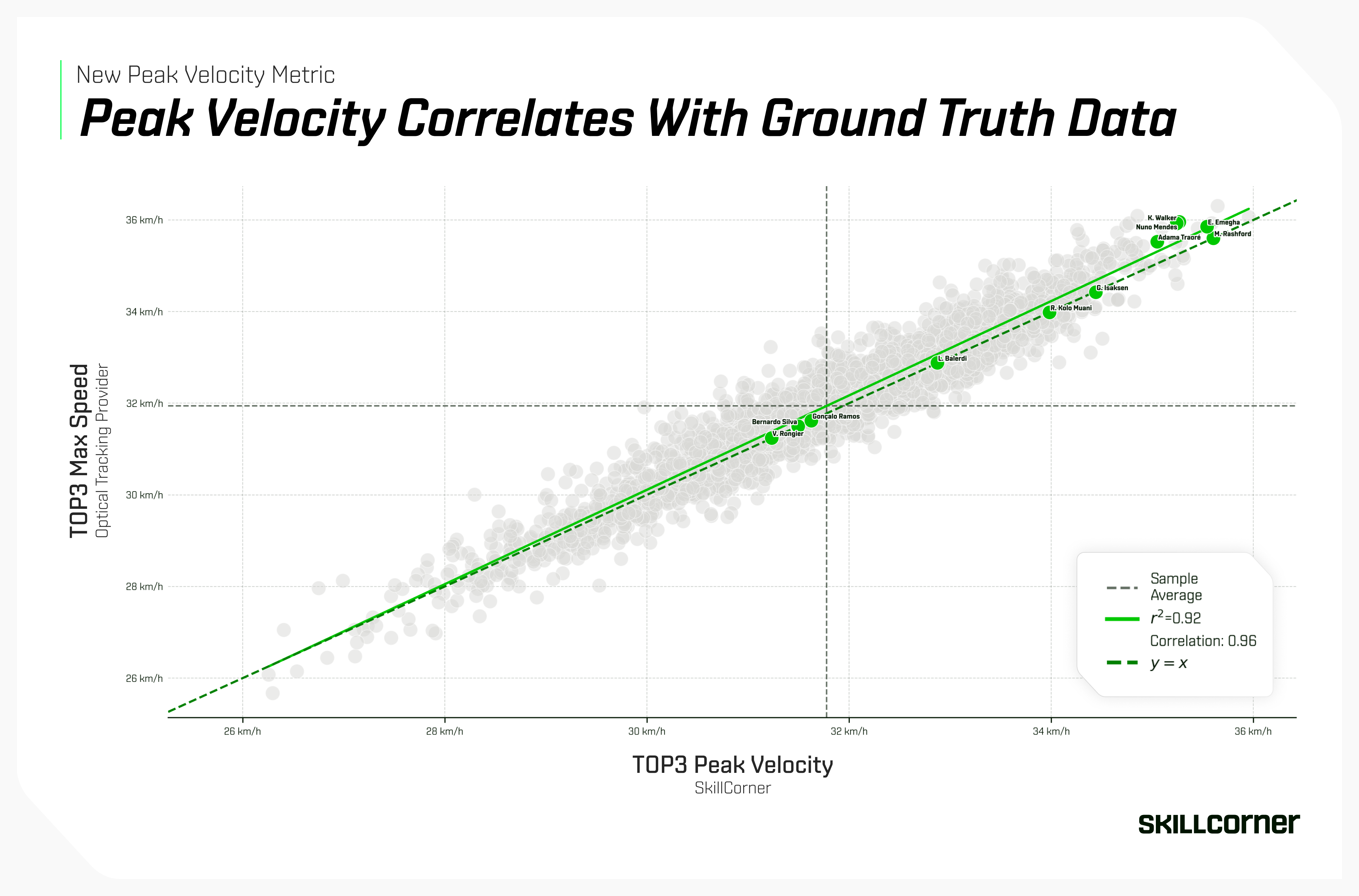
As you can see, there are very few outliers, significantly reducing risk in player assessment and making Peak Velocity the most reliable option for scouting at scale.
Why is Peak Velocity Important For Recruitment Teams?
Peak Velocity provides recruitment teams with a missing layer of physical data they have long desired but never had access to.
If we look at how Peak Velocity values compare to PSV-99 across different lengths of player performance, we can see that even in performances of less than 30 minutes, Peak Velocity provides key additional information on peak physical output. This could act as an early signal for those attempting to identify young outliers as soon as they emerge, even if their minutes are limited.
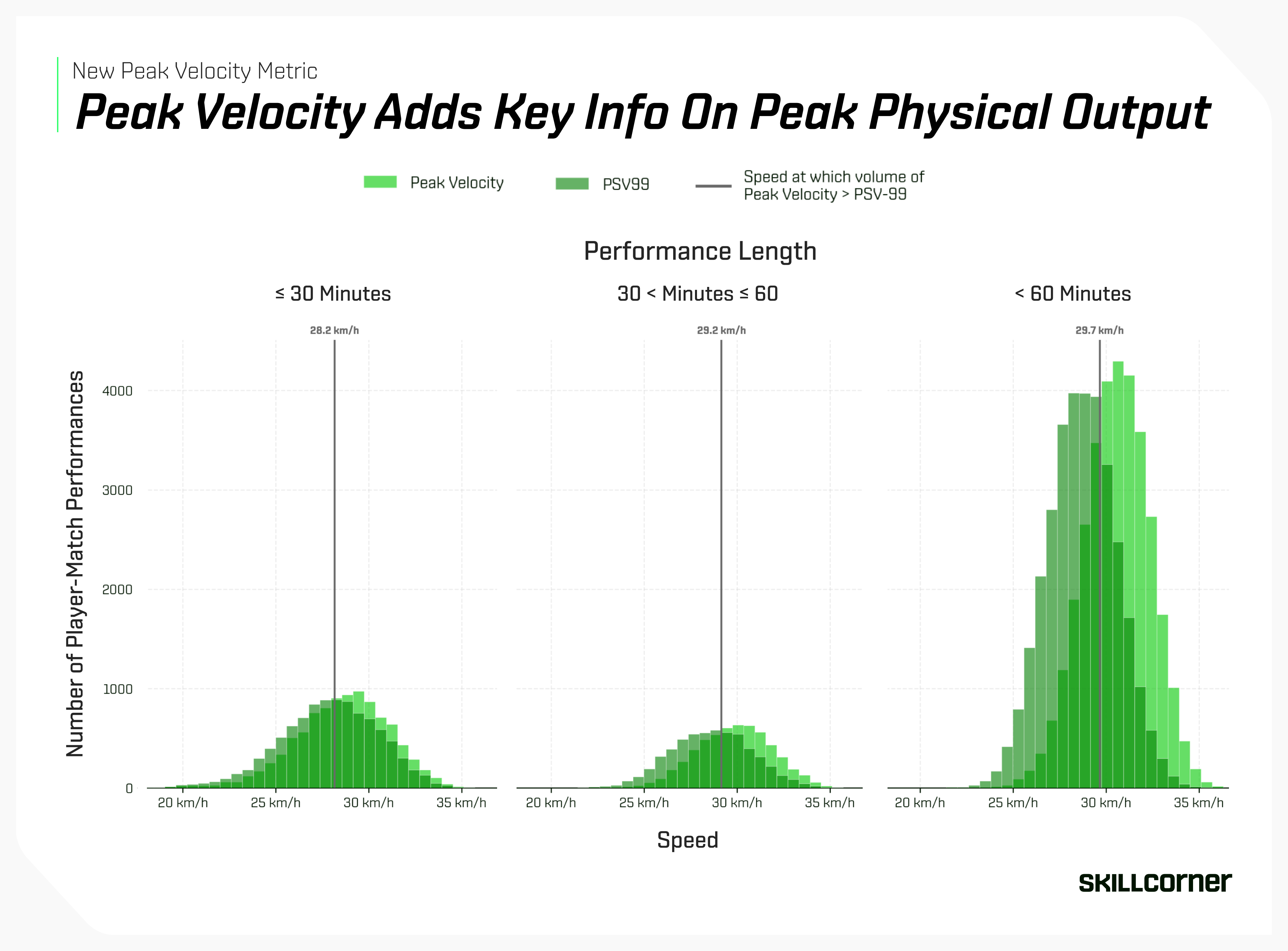
In performances over 60 minutes, a combination of the sample size of physical activities increasing and players having more opportunity to reach their full potential results in a wider gap between Peak Velocity and PSV-99 values. We can see that Peak Velocity identifies spikes of ultimate speed that weren’t captured previously.
Peak Velocity Is Available Now
Peak Velocity has been added to our existing Physical Data package and is now available via WebApp, WebApp Lab and API across all 160+ competitions we cover around the world.
Our customers are already benefiting from access to this consistent and scalable maximum speed data. If that sounds of interest to you, get in touch to find out more.