


Game Intelligence Applied: Centre-Backs Playing Out From the Back
See how SkillCorner data can help identify centre-backs who excel at playing out from the back, particularly those executing the most demanding passes under intense pressure.

In the first blog of the Game Intelligence Applied series, we explored how to differentiate defenders based on their out-of-possession habits using On-Ball Engagements.
Now, we turn our attention to their in-possession impact, focusing on the players who facilitate playing out from the back and advancing through the opponent’s defensive structure. Event data alone cannot fully measure the conditions surrounding a line-breaking pass, often missing the game-specific context. In contrast, SkillCorner's Game Intelligence allows you to measure possessions across different phases of play and analyze how a player's decisions are conditioned by the opponent's press and the spaces conceded by their defensive shape.
This allows analysts and recruitment departments to move away from isolated volume metrics and instead search for specific game situations directly relevant to their game model.
Build up and Create: Progressing and Disorganizing the Defensive Block
To evaluate how centre-backs create an in-possession advantage, we isolate two distinct phases of play:
- Build Up - where the primary objective is to progress the ball and break the initial lines of pressure.
- Create - the focus shifts toward actively disorganizing the opposition’s deeper defensive block, usually positioned in the middle third of the pitch.
Specifically, we look at line-breaking passes played directly through the opposition’s defensive shape - bypassing either the first line of pressure, typically the forwards, or the second-last line, the midfielders. Our focus here is entirely on internal play. Progressing through the center of the pitch and the opposition defensive shape has become a fundamental element of most possession-oriented, dominant teams.
Luis Enrique and Pep Guardiola have spoken multiple times about the importance of progressing internally to develop unpredictable offensive patterns. It is a high-risk, high-reward scenario that rapidly accelerates attacking play.
As a first step in this analysis, we map players generally involved in both the Build Up and Create phases.

When we apply the SkillCorner Pressure Framework to identify which players maintain involvement while actively under pressure, the results shift.
We then start looking at progression and creation. To do so, we explicitly isolate internal line-breaking passes from long, aerial through-balls played into space. We will refer to them as “inside passes”.
Our goal is to identify players who successfully play inside to progress or disorganize the opponent, and then differentiate those who can execute these actions under pressure.
Successful inside line-breaking passes executed under pressure are among the most valuable actions in the game. They break the opposition's press while it is actively engaging, creating opportunities for forward play or third-man combinations. When these passes connect, the defending block is often left disorganized.
We break down “inside passes” into four highly specific situational metrics, differentiated according to the phase of play in which they happen and the degree of pressure the ball carrier is facing at the end of the possession.
1. Inside Passes in Build Up
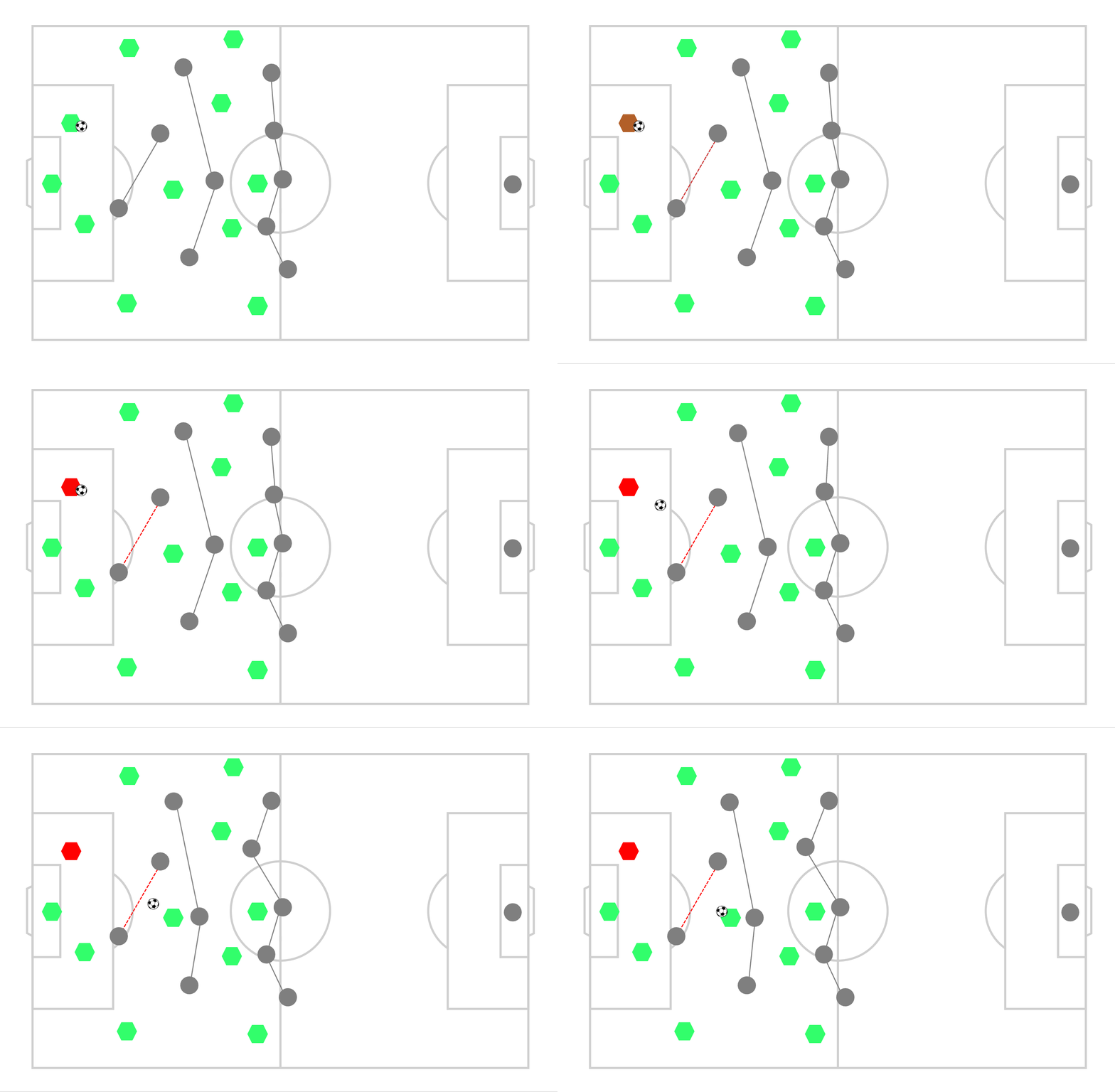
Pass Outcome = Successful
High Pass = False
Furthest line break = First, Second Last
Furthest Line Break Type = Through
Phase Of Play = Build up
2. Inside Passes in Create
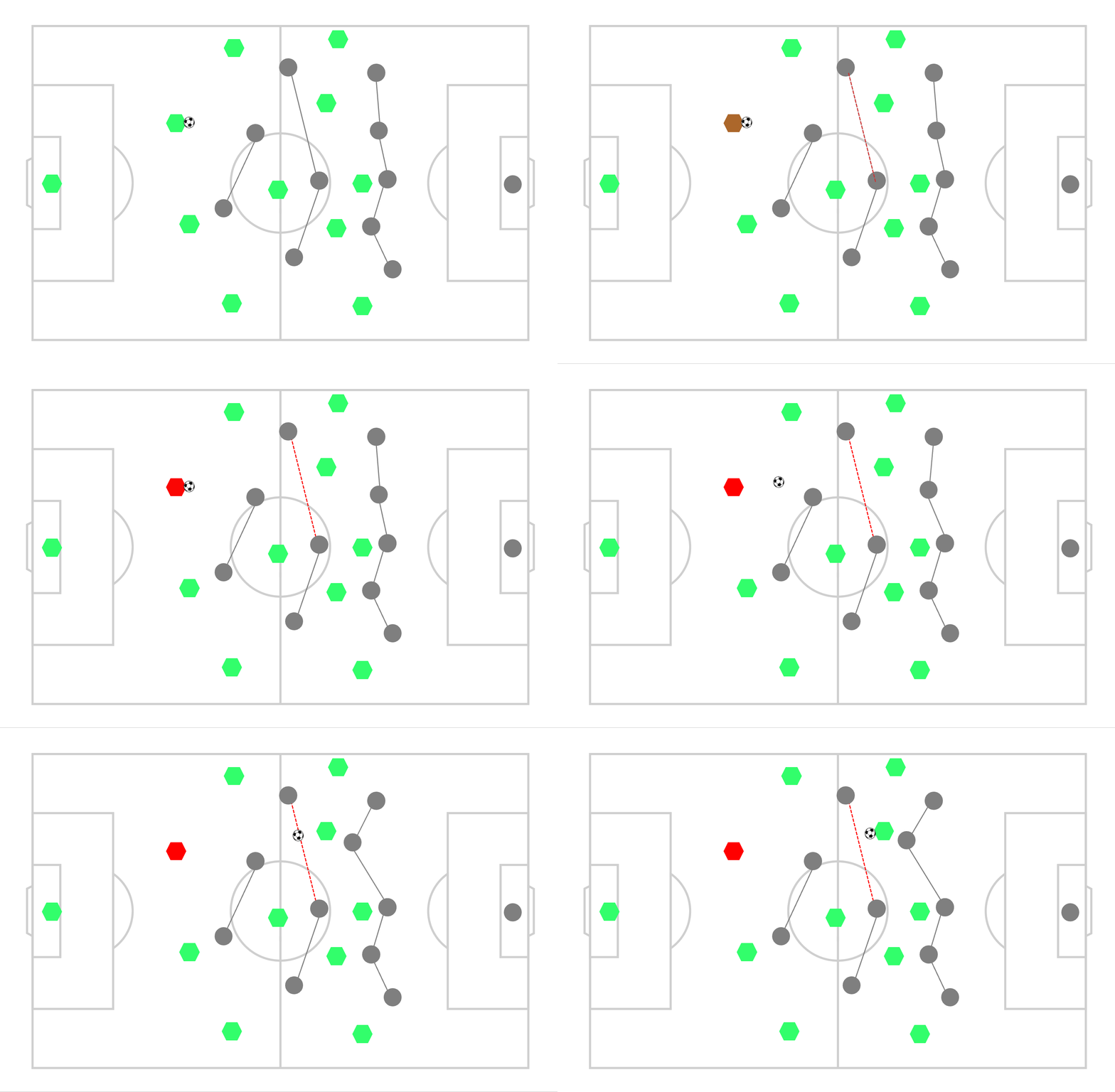
Pass Outcome = Successful
High Pass = False
Furthest Line Break = First, Second Last
Furthest Line Break Type = Through
Phase Of Play = Create
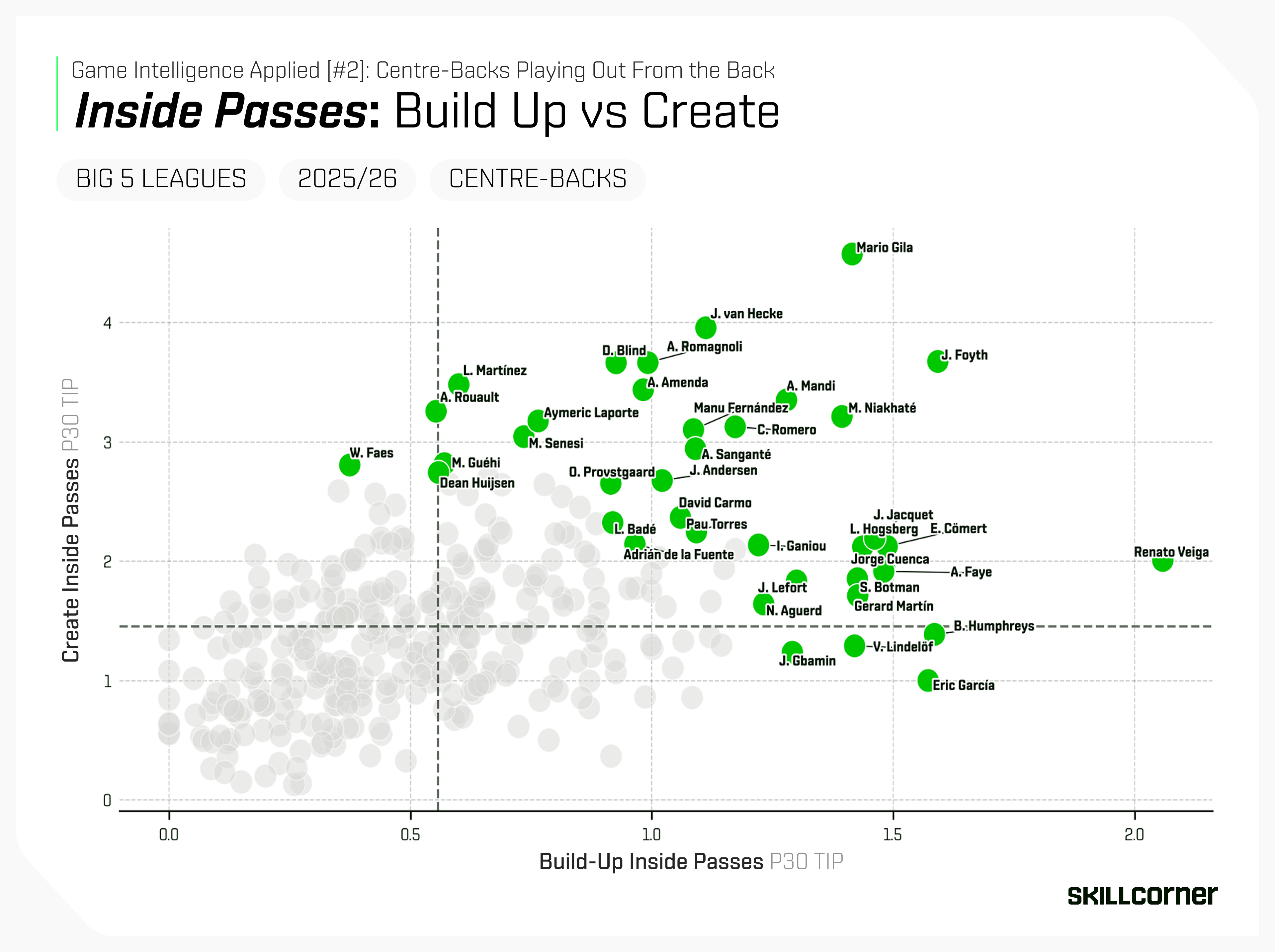
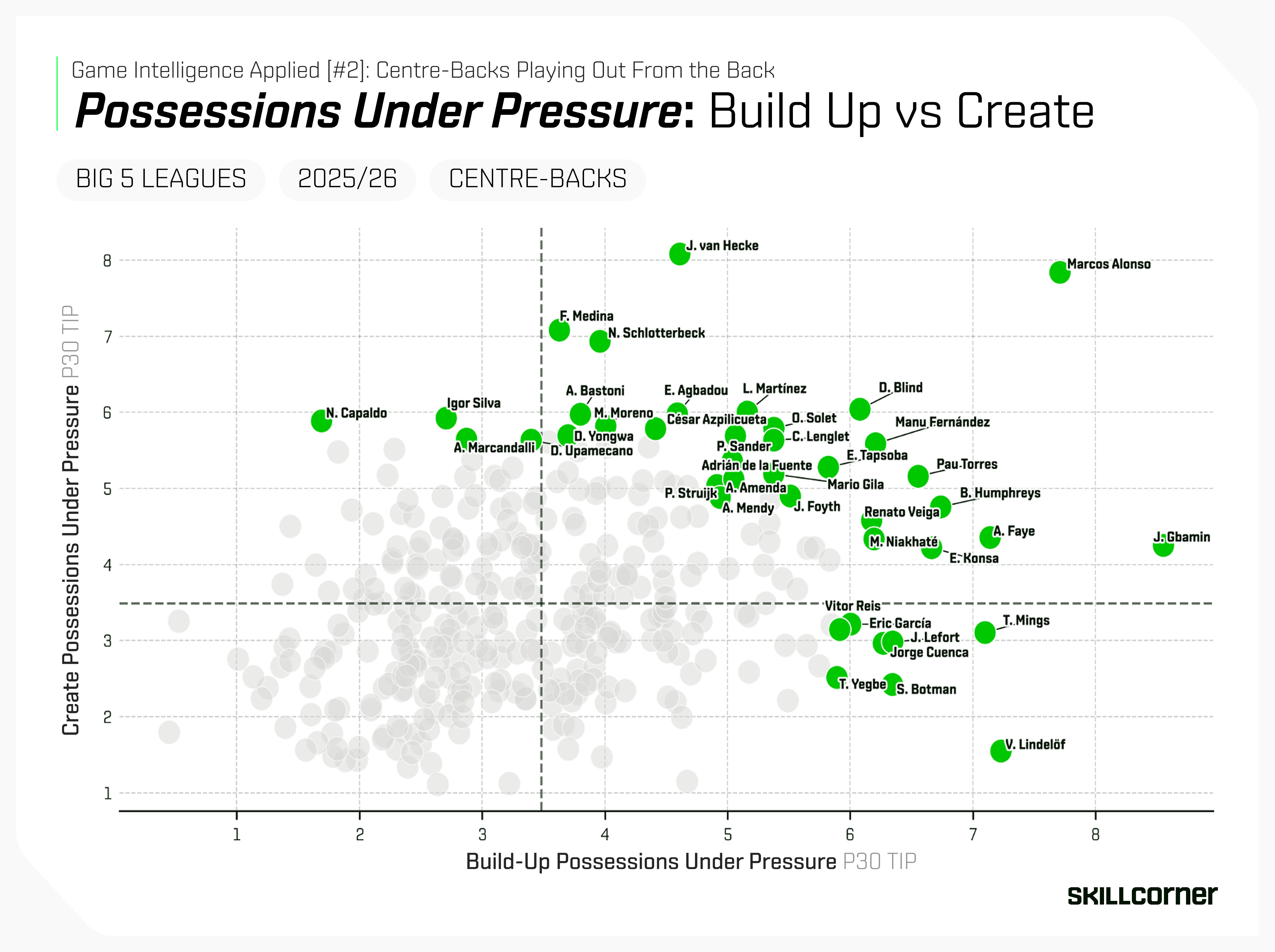
When visualizing these metrics, defenders positioned in the top-right quadrant stand out by ranking highly for internal line-breaking passes in both the Build-Up and Create phases.
Meanwhile, the bottom-right quadrant highlights profiles that specialize in inside passes during the deeper Build-up phase.
Conversely, those in the top-left quadrant represent a different profile: they take on less volume during the initial build-up but stand out for executing line-breaking inside passes during the more advanced Create phase.
3. Inside Passes in Build Up - Under Pressure
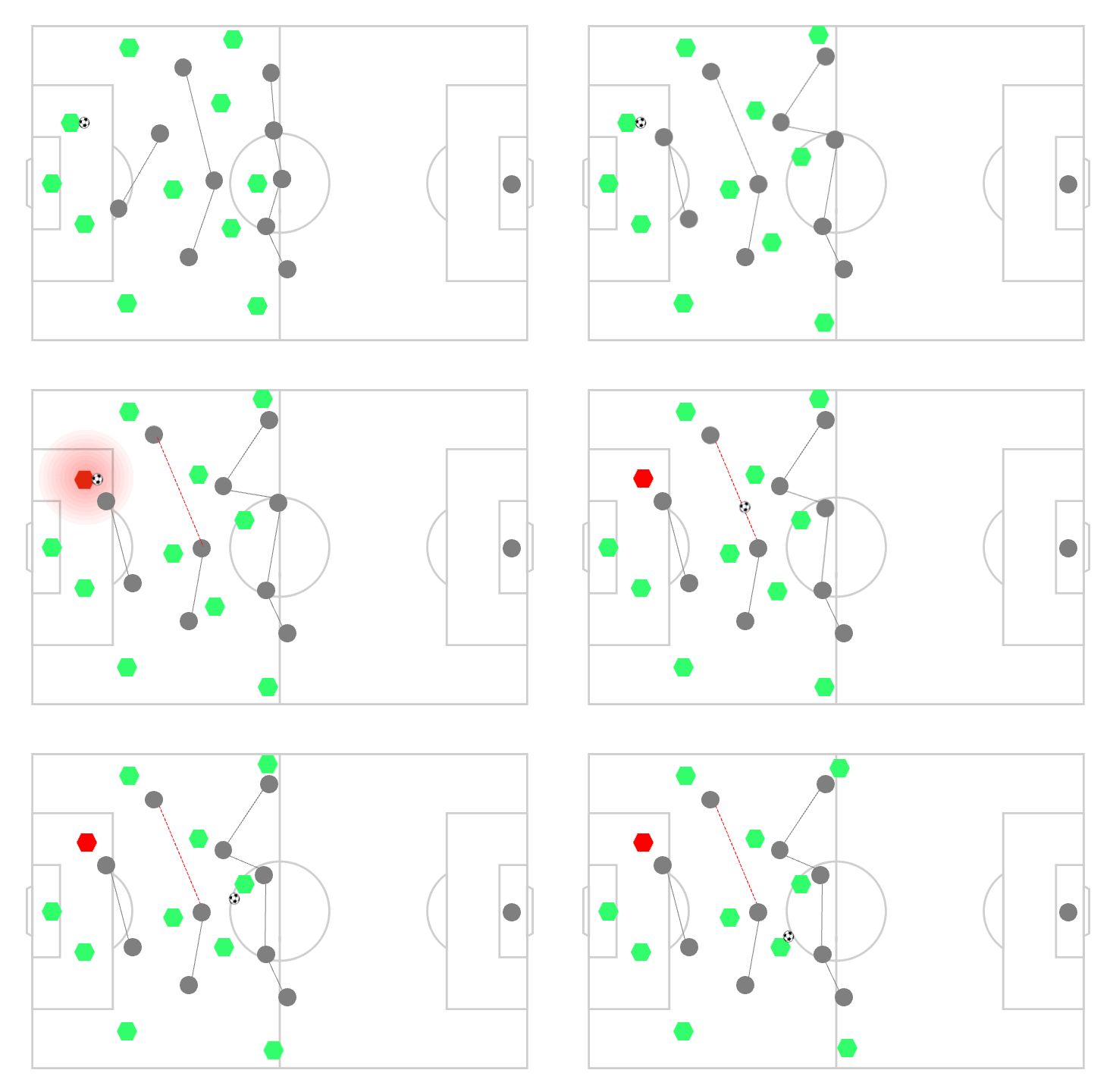
Pass Outcome = Successful
High Pass = False
Furthest Bine break = First, Second Last
Furthest Line Break Type = Through
Overall Pressure Degree End = Medium, High, Very High
Phase of Play = Build Up
4. Inside Passes in Create - Under Pressure
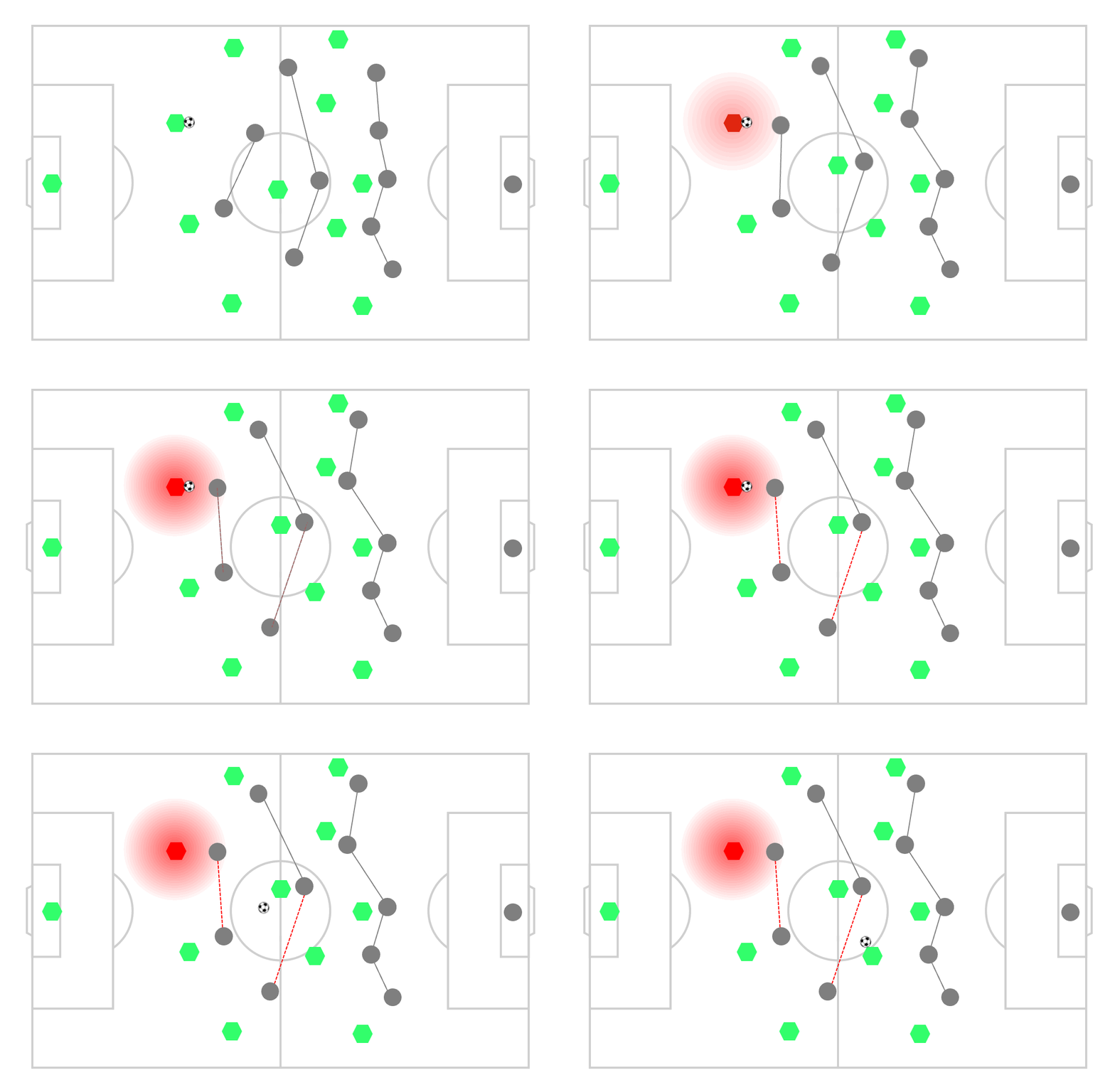
Pass outcome = Successful
High Pass = False
Furthest Line Break = First, Second Last
Furthest Line Break Type = Through
Overall Pressure Degree End = Medium, high, Very high
Phase of Play = Create
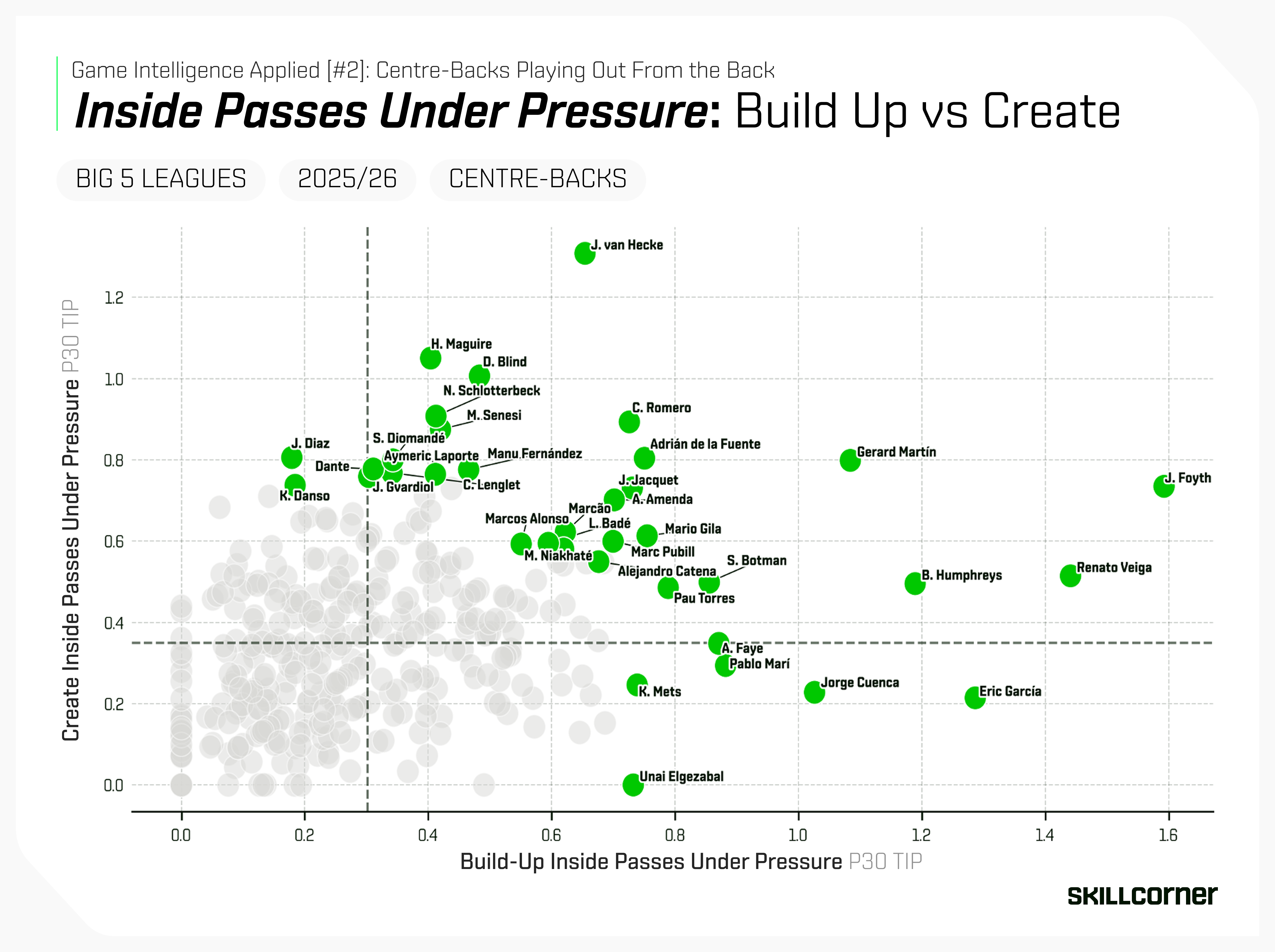
When isolating performance under pressure, profiles that function as elite internal progressors emerge. Defenders in the top-right quadrant successfully sustain their distribution volume when closed down by the opposition. Furthermore, the extreme upper-right captures the outliers: players who consistently execute line-breaking passes across both the Build-Up and Create phases under high pressure situations.
By integrating the defensive metrics developed in our first piece with our new in-possession metrics, we can construct custom player profiles. This allows us to evaluate how elite centre-backs with different off-the-ball profiles execute internal progression when playing out from the back.
Combining out-of-possession profiling with on-ball evaluation provides a concrete measure of a target player's alignment with the tactical demands of a specific game model.
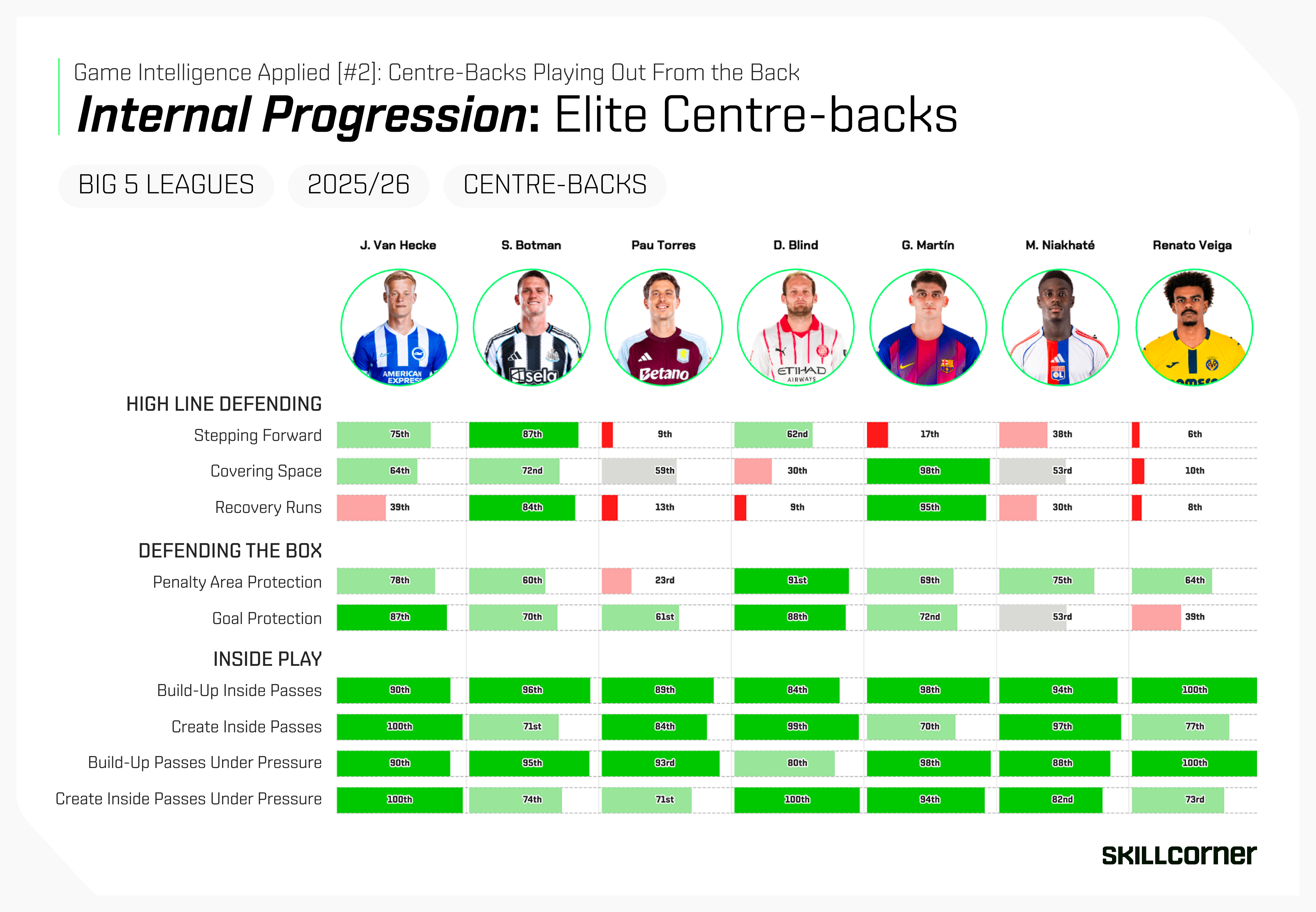
Context is King: Phases of Play, Pressure and the Opposition
With traditional event data, line breaks have simply been recorded as… line breaks, regardless of how or when they occurred. Now, you can factor in the key contextual elements necessary to properly evaluate player performance.
By determining the exact phase of play, focusing on the most relevant playing principles, and modeling the degree of pressure sustained by the ball carrier — accounting for closing speed, available space and passing options, and the technical load required at reception — you can finally isolate specific game situations.
Recruitment staff are now empowered to build their own bespoke situational metrics, tailoring their recruitment directly to the requirements of their playing style.
Unlock the real value of tracking data. Get in touch to learn more about Game Intelligence and our Physical Data.
.jpg)

