

Game Intelligence Applied: Midfielders, From Positioning to Impact
In the second of a two-part series on midfielders, we from move positioning to impact: combining Dynamic Events and EPV to measure what they create from the spaces they occupy.
In Part 1, we differentiated midfielders by how they position and move off the ball — the deep builders, the diagonal receivers inside the block, and the channel-runners. It established where players tend to show up.
In this second part, we evaluate the choices and the impact that follow from receiving in those positions, once the player gets on the ball.
To do so, we combine SkillCorner's Dynamic Events — mainly Passing Options, Off-Ball Runs and Player Possessions — to recreate specific game situations, and we add a new layer: Expected Possession Value (EPV).
EPV measures the probability of each team scoring at any given moment in a match. The change in that probability following a player's action on the ball is a measure of their impact. It lets us ask not just where a midfielder receives, but how much their involvement contributes to the team.
What follows is one example of building metrics around a specific performance question. With the flexibility of Dynamic Events, the same logic can be reshaped to fit any given game model.

From Options to Impact: Outside or Inside the Block
We previously separated midfielders by whether they position themselves outside the defensive block or diagonally inside it. Now, we look at the impact they generate when they receive the ball.
We benchmark players on two counts:
- First, not simply positioning themselves outside the block, but going on to progress the team from one phase to the next — from Create to Finish — when involved in the resulting possession chain.
- Second, the impact they have on the probability of scoring when receiving diagonally inside the block, measured through their EPV values.
Read together, the two axes separate distinct profiles.
J. Kimmich, M. Locatelli, Vitinha, Rodri and A. Pavlović are consistently involved in possessions that progress the team into the final third.
E. Kroupi, Bruno Fernandes and I. Sarr register the greatest impact when receiving diagonally inside the block, while Pedri and M. Ødegaard rank highly on both counts.
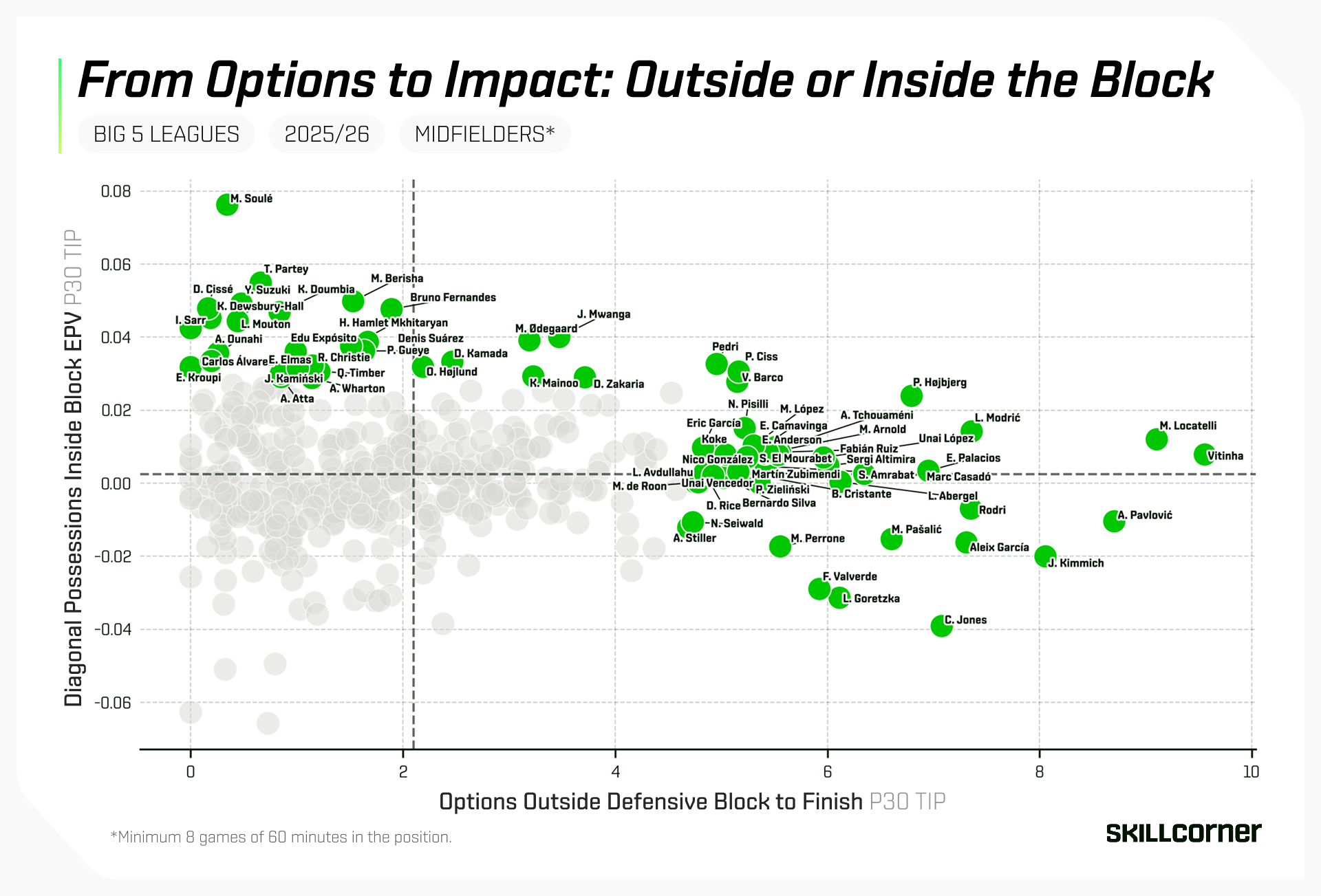
Options Outside the Defensive Block to Finish - Flags
player_position = DM, LDM, RDM, LM, RM, AM, CM
event_type = passing_option
team_in_possession_phase_type = 'create'
inside_defensive_shape_end = FALSE (option)
interplayer_direction != 'forward'
Resulting player possession:
end_type='pass' OR carry=TRUE,
current_team_in_possession_next_phase_type='finish'
Diagonal Possession Inside Block - Flags
player_position = DM, LDM, RDM, LM, RM, AM, CM
event_type = passing_option
inside_defensive_shape_start = TRUE
interplayer_angle BETWEEN 20 & 60 OR -60 & -20 ·
n_opponents_bypassed >= 1
received = True
Resulting player possession:
possession_epv_total + pass_epv_total
When Inside the Block: Passing vs. Carrying
The same diagonal reception can create value in two ways: through the carry that follows it and/or through a pass at the end of that carry. Using the separate EPV flags available within Dynamic Events, we can split a midfielder's diagonal impact by action type: contribution produced from possessions (carries) against value produced from passes.
N. Paz, O. Sancet and A. Atta generate greater impact through passing. I. Sarr, J. Enciso and M. Rogers do so through carrying.
E. Kroupi, Bruno Fernandes and A. Ounahi tend to produce value both ways.
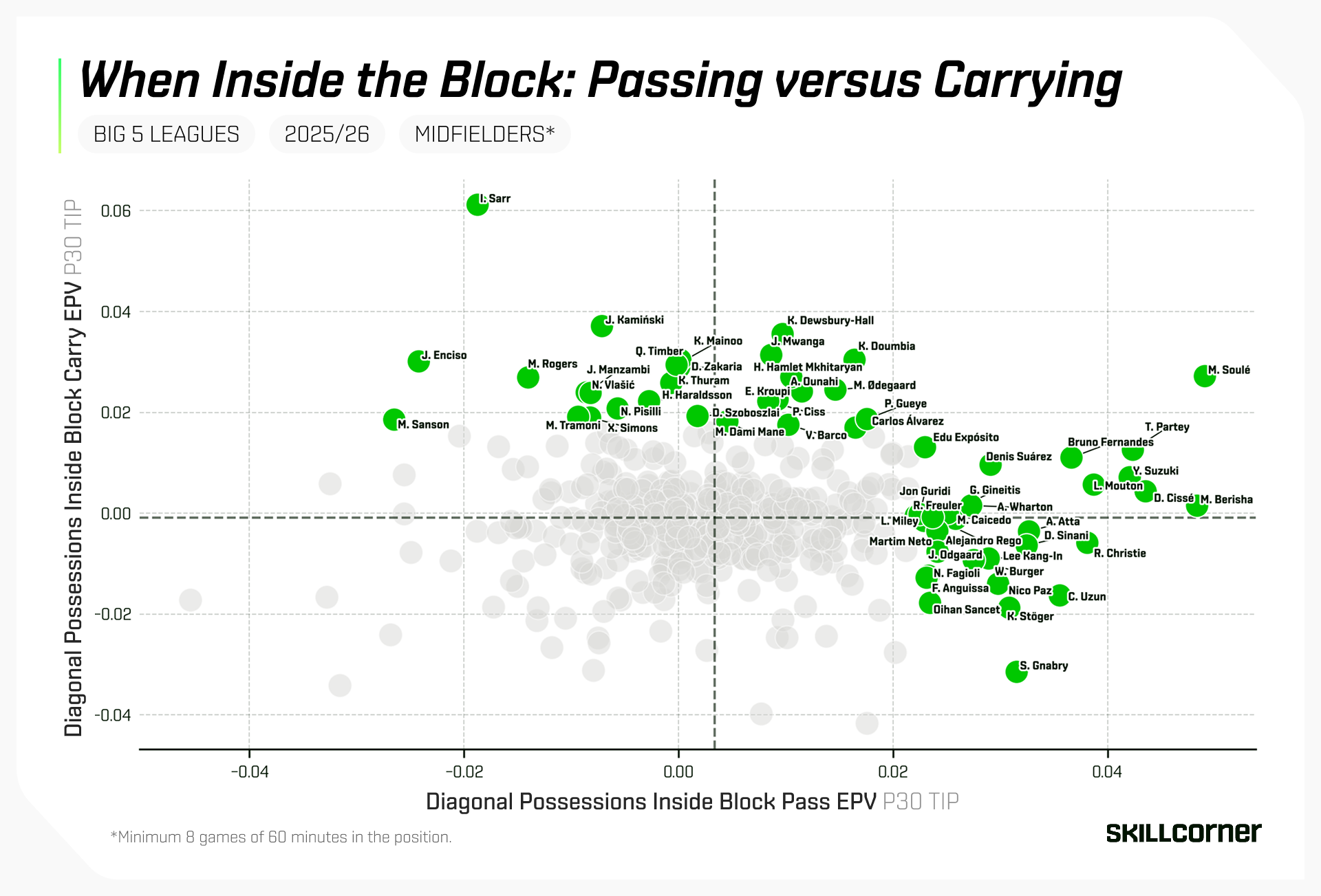
Diagonal Possession Inside Block - Flags
As above, but isolating a single value to measure the contribution from either a carry or a pass
possession_epv_total OR pass_epv_total
Progression, Impact and Circulation
Receiving outside the block to progress the team, or diagonally inside it to create impact, are not the only choices available to a midfielder from those positions. From the same diagonal reception, a player can also act as what’s called a “third-man passer”.
Here, the midfielder helps the team circulate the ball to find a free teammate who can face forward more cleanly, shifting the opposition's pressure and opening a route to advance. Specifically, the player is the second link in a three-man combination: receiving under pressure or unable to contribute directly, they quickly release to a close, better-positioned or forward-facing teammate.
Aleix García, K. Taylor and Dani Parejo operate more as “third-man passers”.
Bruno Fernandes, T. Partey and A. Wharton tend to do both.
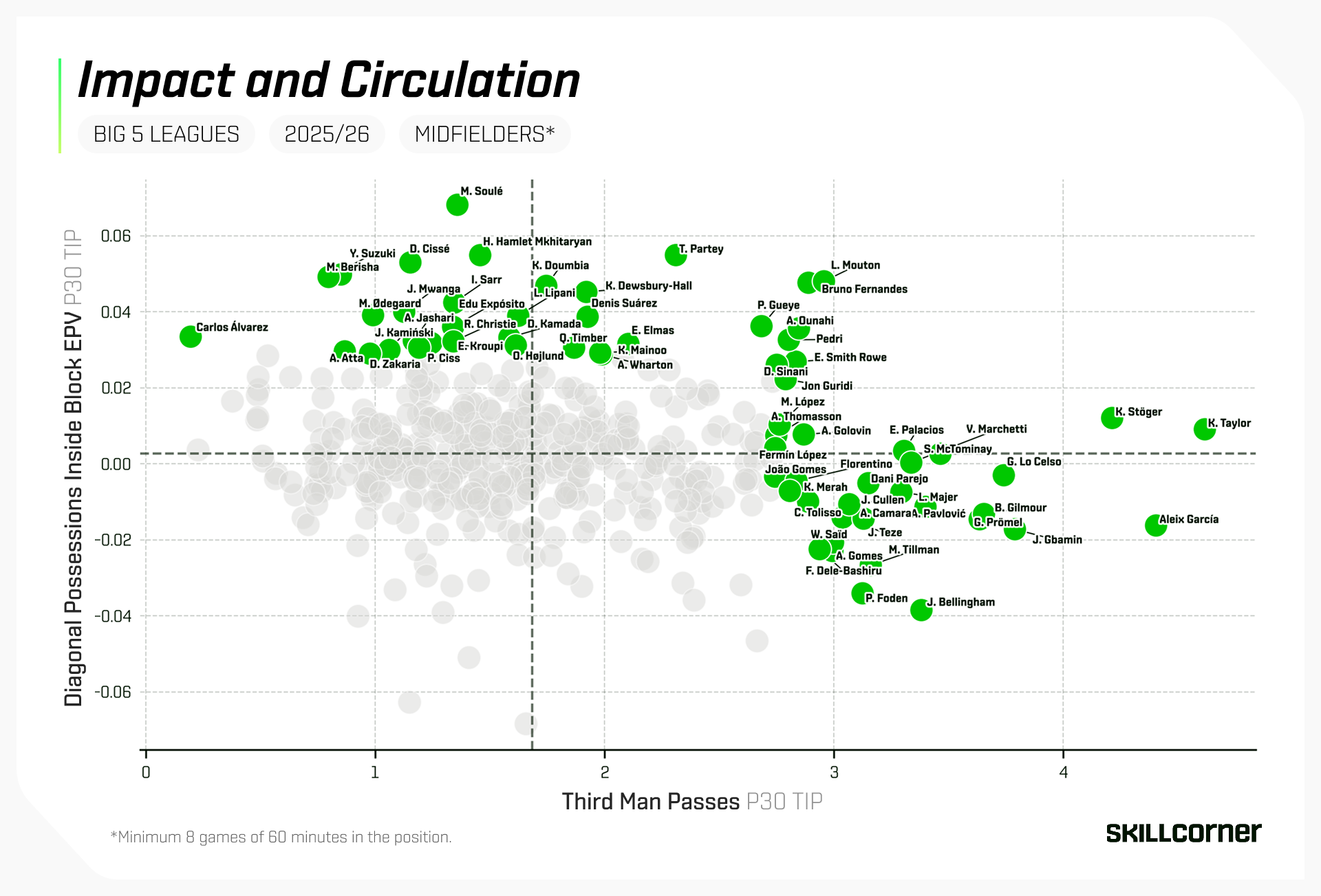
Third Man Passer - Flags
player_position = DM, LDM, RDM, LM, RM, AM, CM
event_type = passing_option
inside_defensive_shape_start = TRUE
interplayer_angle BETWEEN 20 & 60 OR -60 & -20 ·
n_opponents_bypassed >= 1
received = TRUE
Resulting player possession:
interplayer_distance >= 5
quick_pass = TRUE OR one_touch = TRUE
pass_angle > 70
Calculating the Impact of Channel Runs: An Example
In Part 1, we ranked midfielders by the volume of their channel runs. Here, we use EPV to ask how valuable those runs actually are: the impact a received run has on the team's probability of scoring.
To do this, we take the EPV value recorded at the moment the runner receives the ball. Credit for the action is indeed shared with the passer who finds the moving teammate; here, we look to recognise the runner's movement in opening the opportunity, using this value as a proxy for its quality, potentially complementing other flags carried by the off ball runs (xT, Dangerous…).
W. McKennie, J. Bellingham and D. Olmo rank highly for Channel Run Reception EPV.
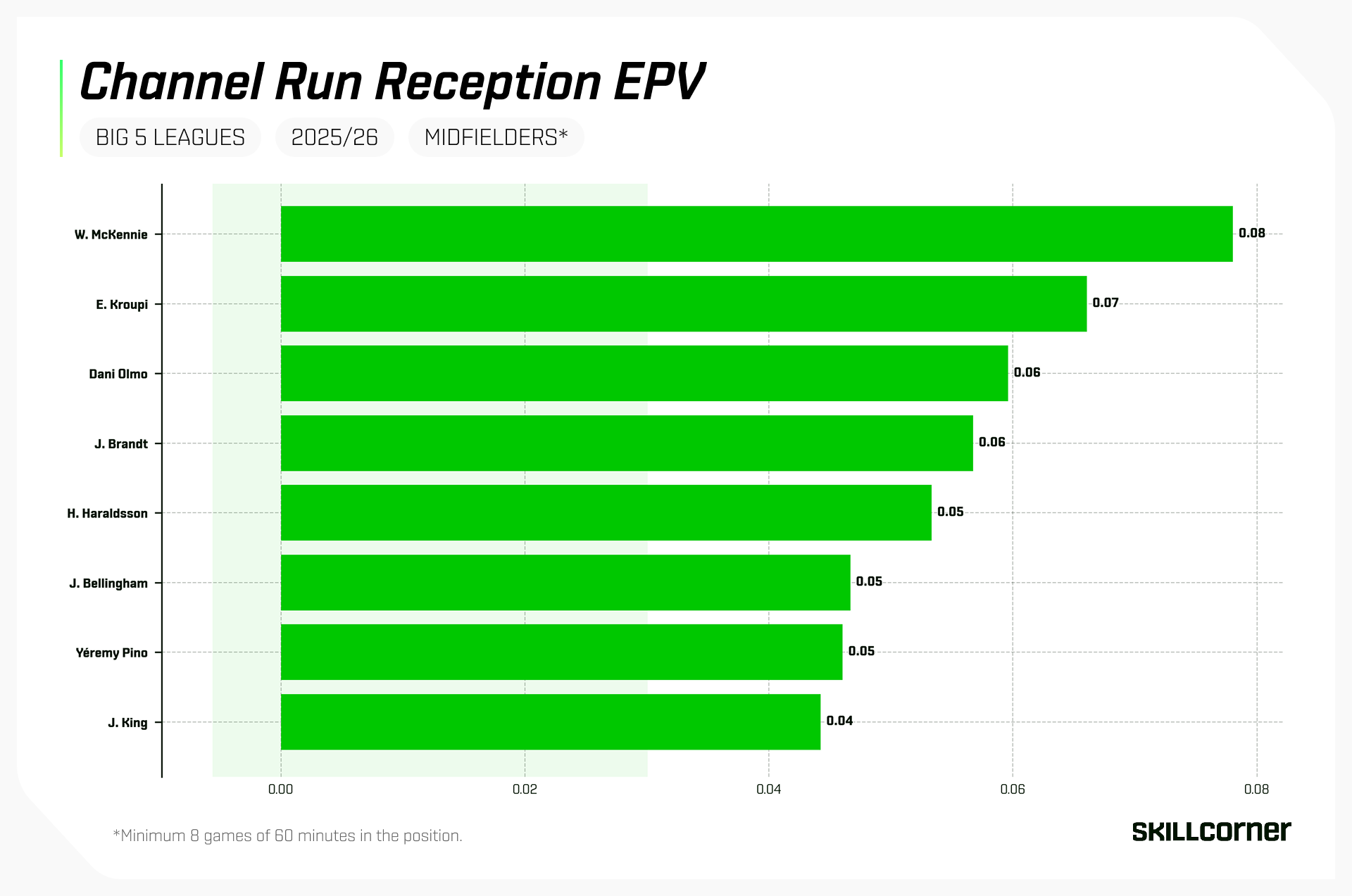
Channel Run Reception EPV - Flags
player_position = DM, LDM, RDM, LM, RM, AM, CM
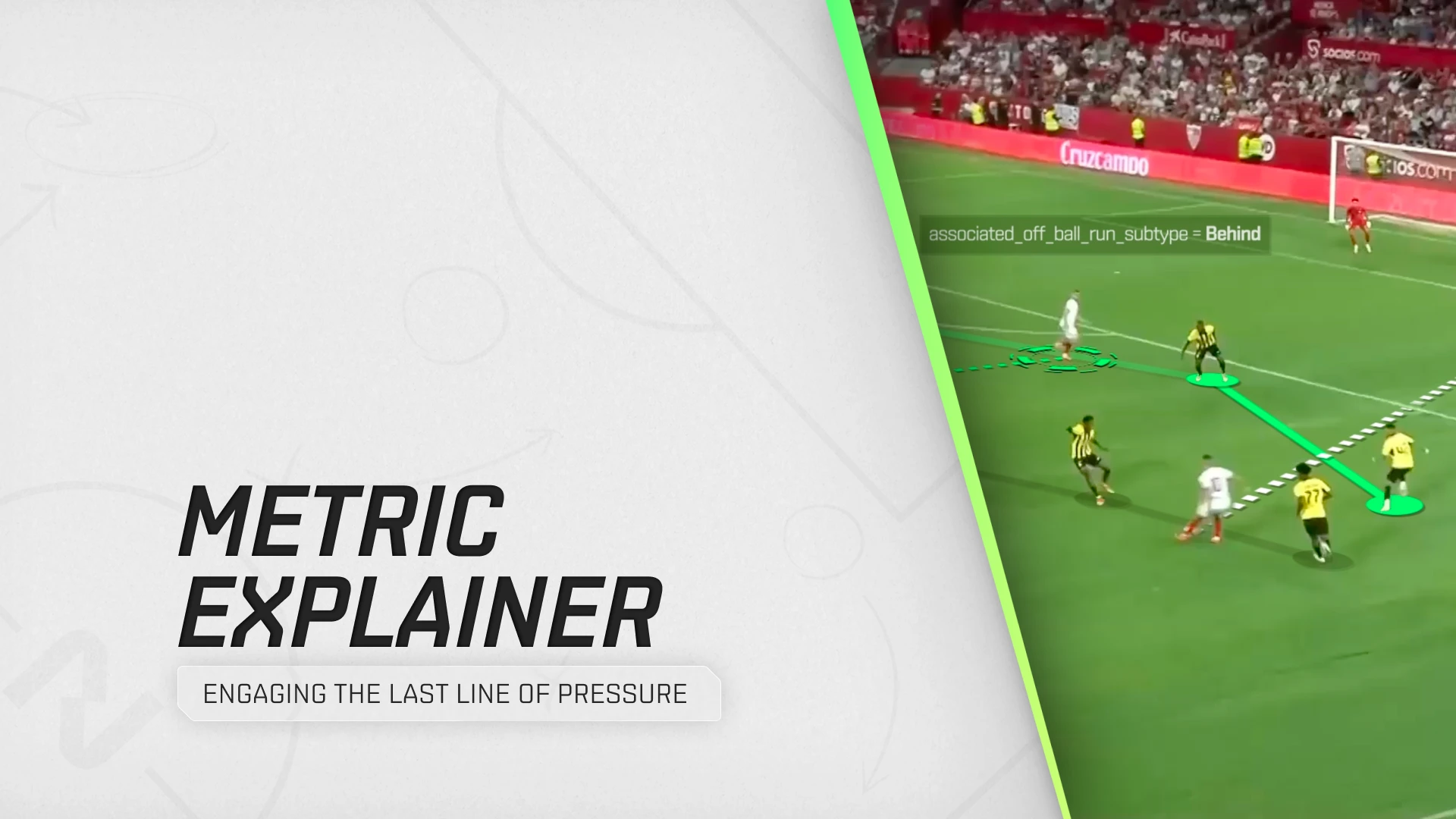
associated_off_ball_run_subtype IN ('behind', 'cross_receiver')
channel_start IN ('center', 'half_space_left', 'half_space_right') · speed_avg >= 20
received = True
Previous (passer’s) player possession:
pass_epv_total
The Complete Picture
Bringing these threads together, we arrive at a more complete picture of a midfielder: not only how they position and move off the ball, but the impact they create once they receive.
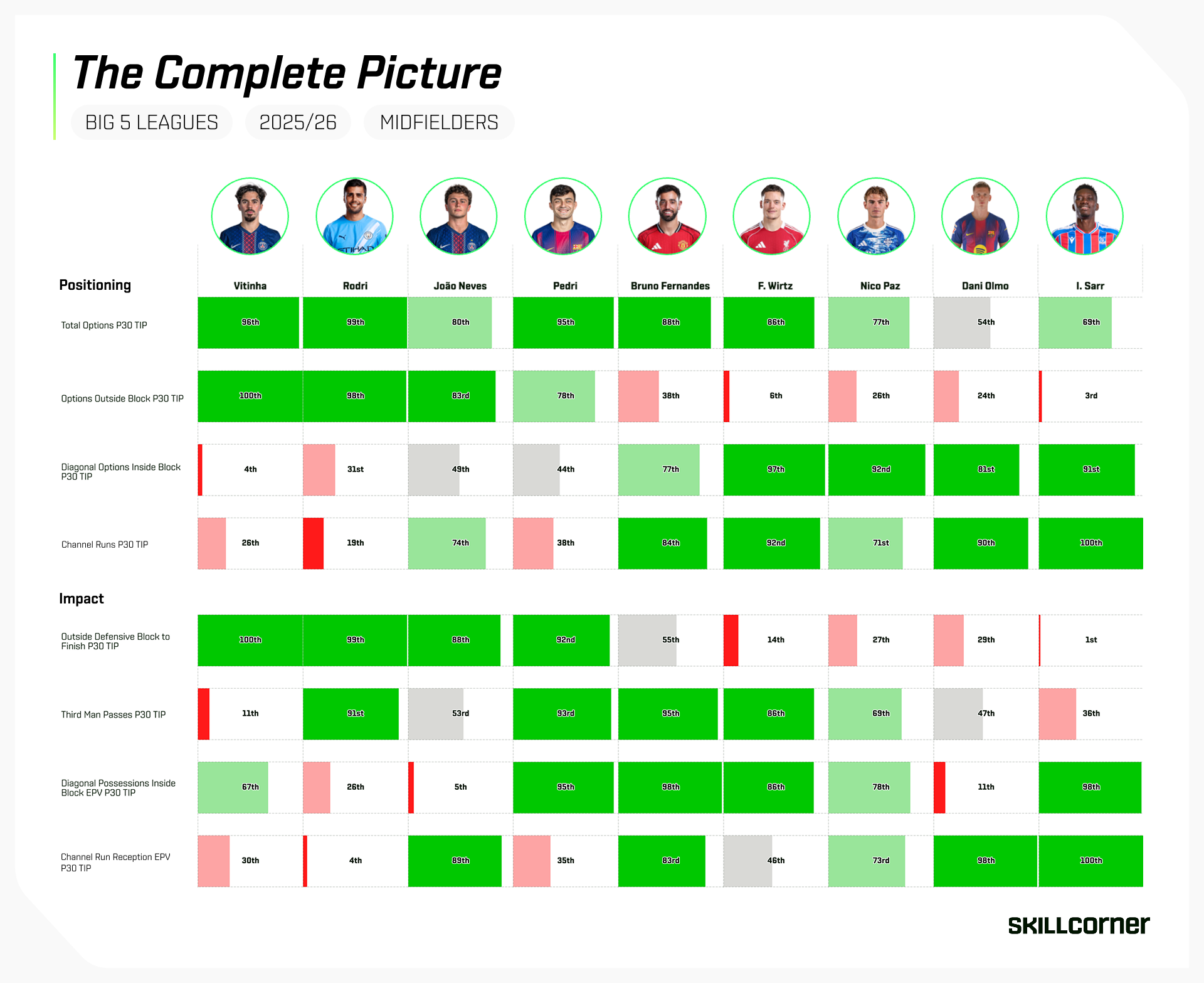
This is just one example of the depth of analysis made possible by the richness of the event-level data within our Game Intelligence package. Get in touch today to find out how it could be applied to your own recruitment process.