


SCOUTED: Exploring the South Africa to MLS Pipeline
The world is waking up to South Africa, and nowhere more so than Major League Soccer. SCOUTED investigate this emerging pipeline.

Bafana Bafana’s 2026 World Cup squad was dominated by players based in South Africa, specifically the top two teams in 2025/26: champions Orlando Pirates and runners-up Mamelodi Sundowns. The only other league represented by multiple players in the squad was Major League Soccer. By 2030, we not only expect MLS representation to increase but for the squad to become much more diverse. Here's why.
As of May 2026, the USA was the most common destination for South African players per the CIES Atlas of Migration. More players are leaving South Africa to play in the United States than any other nation. Granted, that table-topping number stands at just six. But there is plenty of evidence to suggest it will continue increasing over the coming years. The first of which comes straight from source.
2005-born centre-back Mbekezeli Mbokazi is the poster boy of this emerging trend. We highlighted his ambitious, penetrative passing as a bonafide superpower in our post World Cup analysis but MLS fans would have already been familiar with his game prior to this mainstream breakout. He signed for Chicago Fire from Orlando Pirates in December 2025 and his performances before the tournament break secured him a spot as an MLS All-Star, although he sadly missed the game due to injury.
We contacted the Fire for comment about their recent shopping trips to South Africa and Gregg Berhalter, Director of Football & Head Coach, explained why more franchises are likely to follow suit.
“I think South Africa is going to become a real pipeline for MLS, and I don’t think that’s a stretch. With Mbokazi, what stood out wasn’t just his physical attributes—it was his composure on the ball and his ability to read the game a step ahead of most centre-backs his age. Puso [Dithejane] brings a different profile. He has real technical quality, is comfortable in tight spaces, and fits the way we want to play.

“The PSL has genuine quality, and South Africa stands out across Sub-Saharan Africa because of the availability of player data. That gives clubs like ours much greater confidence in evaluating players before they ever step foot in Chicago. As more MLS clubs become comfortable with that pathway, I expect you’ll continue to see more South African players making the move.”
Berhalter is keen to stress that there are factors beyond physicality that make South Africa an excellent pool to fish from. However, the level is so impressive that it must be highlighted.
Over the summer, we have been developing a Physicality Matrix that allows us to snap asses a division’s athletic level and style as well as discover idiosyncrasies for leagues across the globe. The matrix splits SkillCorner’s Physical Data into five key branches of athleticism, the same buckets we use for our SCOUTED Pro reports.
- Coverage
- Agility
- Speed
- Explosiveness
- Intensity
After calculating an individual tier for each branch, it then computes a composite Physical Score for all five areas to provide a general benchmark, scoring them from 0 to 100.
When looking at the Per 90 output for 41 global leagues in 2025 and 2025/26, it’s no surprise to see that the English Premier League ranks first. By a long way; the gap between first and second is the largest between two leagues in the entire dataset. What we didn’t expect to see was the South African Premiership ranking above MLS and closing in on the top 10.

Discover League Idiosyncrasies with Physical Data
41 global competitions • 2025, 2025/26 full campaigns • Per 90 output for average player in each league

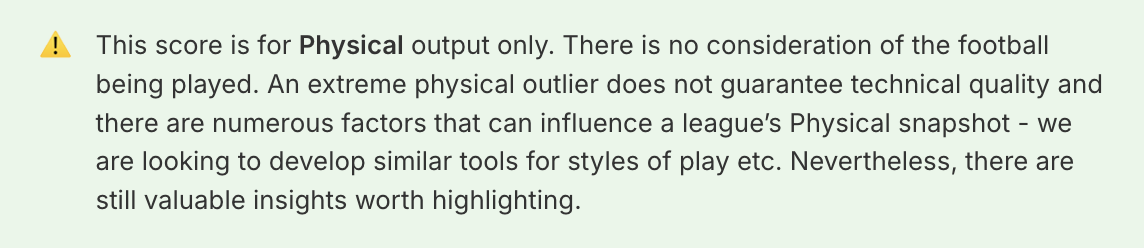
Each tier is calculated independently: The five buckets are separate models. No metric appears in more than one bucket, so the dimensions do not double-count each other.
How a tier is assigned: Every metric is converted to a Z-score against the 41-league sample. Each bucket is a weighted sum of its own metrics' Z-scores, with weights summing to 1. That bucket score is then re-standardised and graded on fixed thresholds: S above +1.5σ, A above +0.5σ, B within ±0.5σ, C below −0.5σ, D below −1.5σ.
Tiers mean the same thing in every bucket: Because the thresholds are fixed rather than fitted to each bucket's own distribution, an S in Coverage is the same statistical bar as an S in Speed. S-tier is deliberately rare: just nine S-grades exist across 41 leagues and five buckets.
Physical Score is the only figure that combines all five. Each bucket is re-standardised so none dominates through having a wider spread, the five are averaged with equal weight, and the result is scaled so 50 = sample average and ±3 SD spans 0–100.
| League | Physical Score |
|---|
The next headline is that the PSL is one of only three S-tier leagues for Explosiveness. The major driving force behind this is a number one ranking for Time to HSR - a league-wide average of the Top 3 Times recorded by every player. Beyond that, only the English Premier League can better South Africa’s top flight for Explosive Accelerations to HSR - it’s is also the highest-ranked non-European league for Explosive Accelerations to Sprint.
The only concern about the PSL is the C-tier ranking for Coverage, which focusses on distance covered regardless of speed. Even then, the PSL ranks first for both High Accelerations and Decelerations. and while the below average output for the pair of Time to 505 metrics negatively affects their Agility tier ranking, it further distinguishes the PSL as one of the most bursty leagues in the dataset, punctuated by sharp actions even if the volume demands fall short. This is what makes it such an attractive market.
Accelerating and decelerating are key skills when it comes to both sides of 1v1s. Being able to close space but control speed as to not over commit is a trait that separates the elite defenders from the rest. On the other side, slowing opponents down before bursting past them with the ball is a common characteristic of 1v1 demons. Explosiveness can even augment off-ball movement: creating maximum separation in a short window can be the difference between tapping into an empty net or seeing the ball flash across the box.
What makes South Africa an interesting proposition for MLS franchises specifically is that they are the same, but different. Just 0.2 points separates the leagues on the Physical Score ranking.
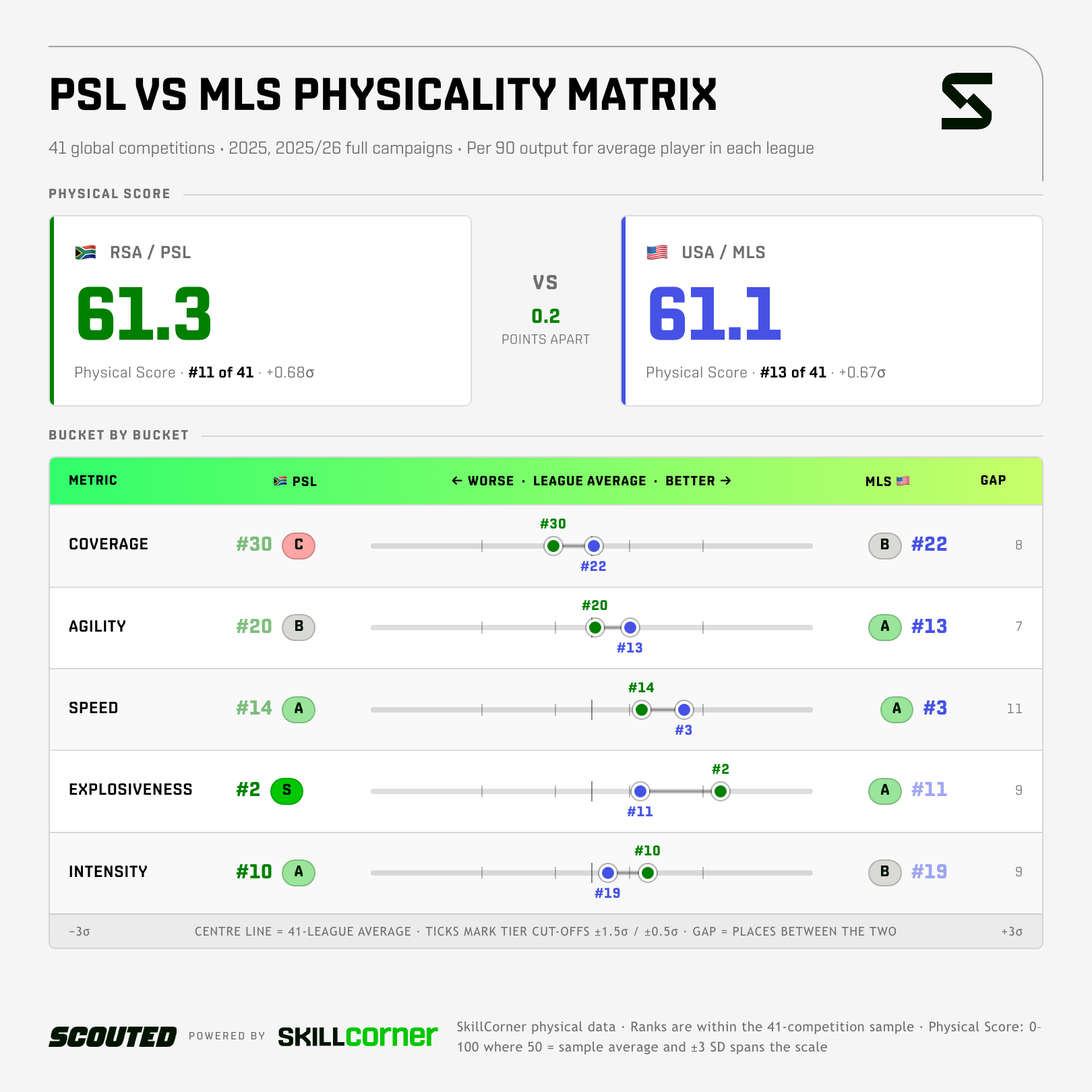
However, while the PSL focuses on those initial bursts and changes of direction, MLS indexes more into straight-line Speed; it ranks third behind Ligue 1 and the only S-tier league, the Premier League. South Africa therefore provides a pool of talent with additive athletic qualities while also operating at a higher Intensity. Best of all, it can be secured at minimal cost.
The next trait highlighted by Berhalter was Mbokazi’s composure on the ball. Since our aforementioned post-World Cup feature, SkillCorner have introduced their Expected Possession Value (EPV) model which further illustrates Mbokazi’s on-ball impact.
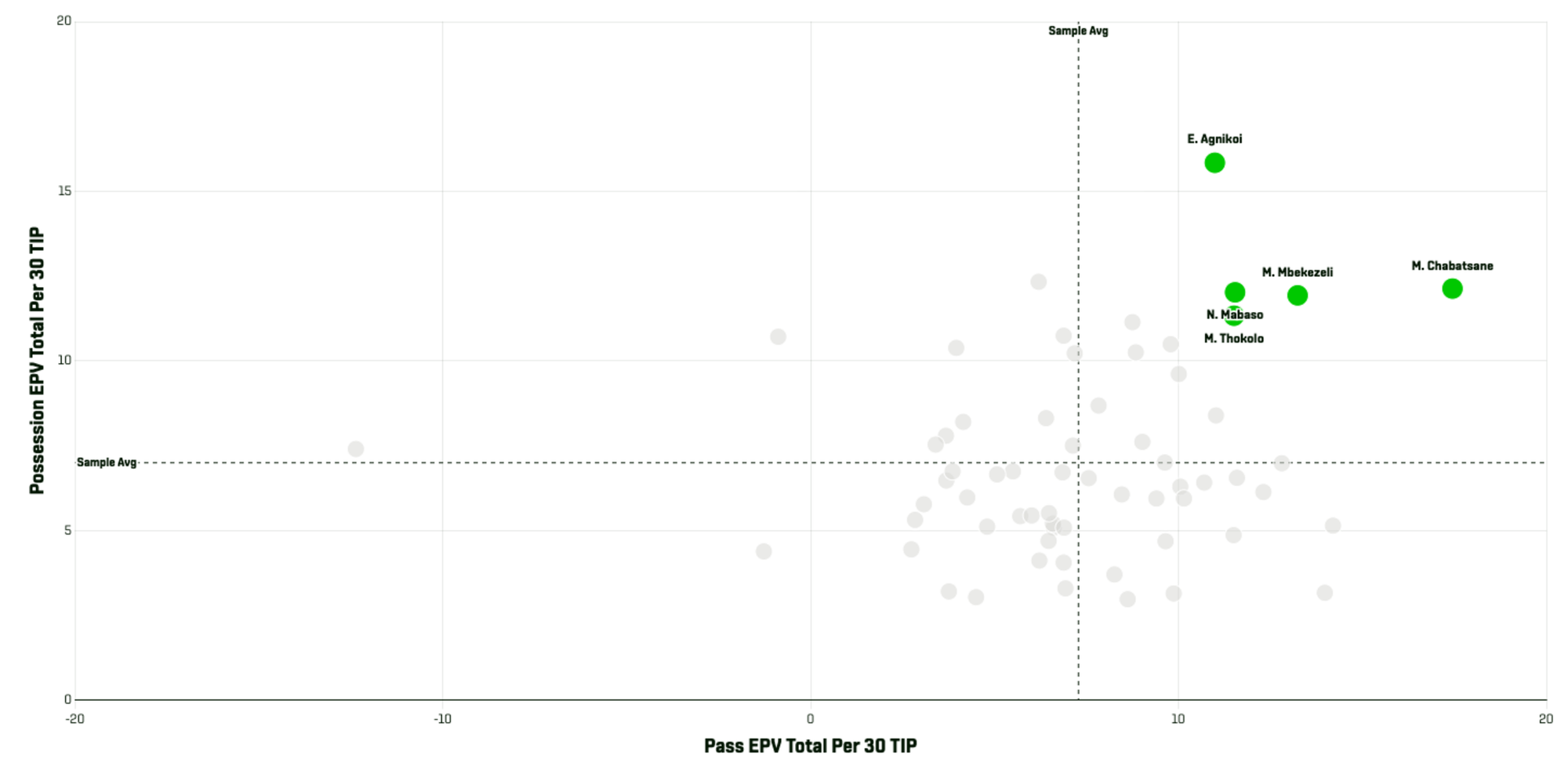
The top five centre-backs for Overall EPV Per 30 TIP - highlighted in the above scatter - are all relatively young, with three of them, including Mbokazi, eligible for an MLS U22 Initiative Slot. Eroine Agnikoi is from Cote d’Ivoire - the PSL has a steady stream of Ivorians into the league which is another benefit of scouting the league - and profiles as a high-intensity wide centre-back. But given the focus is on South Africans, let’s see if Ntandoyenkosi Mabaso ticks the same boxes as Mbokazi.
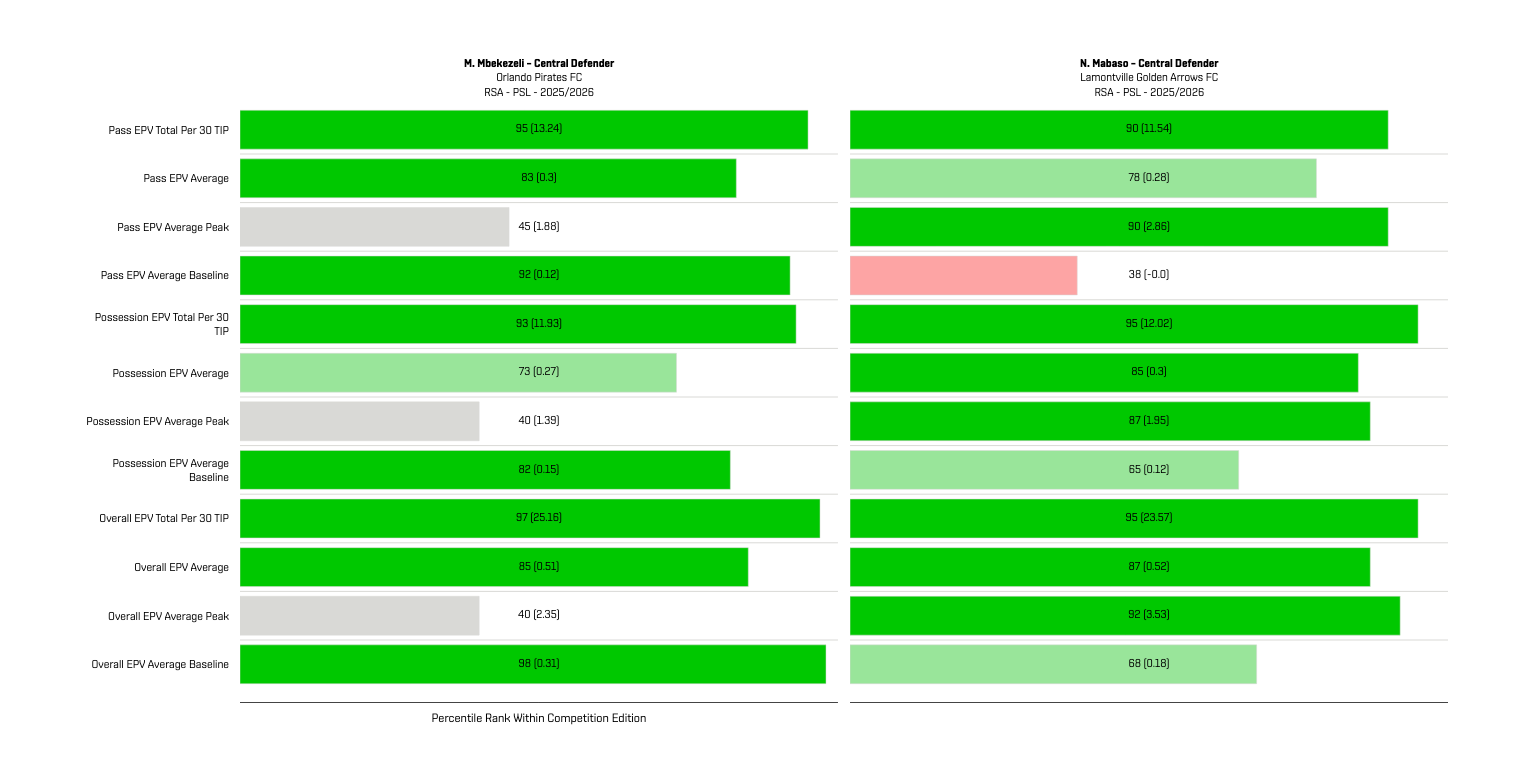
To summarise this full breakdown, Mbokazi is more consistent with the value he adds via both passes and individual possessions - Average and Baseline variants - while Mabaso has demonstrated an ability to execute high-value actions - the Peak variants of the EPV. Remember, though, that both players ranked in the top 5% for centre-backs when it comes to Overall EPV Per 30 TIP.
A quick snapshot of Passing metrics shows that Mabaso is not quite as expansive as Mbokazi - but that, in turn, makes him more efficient.
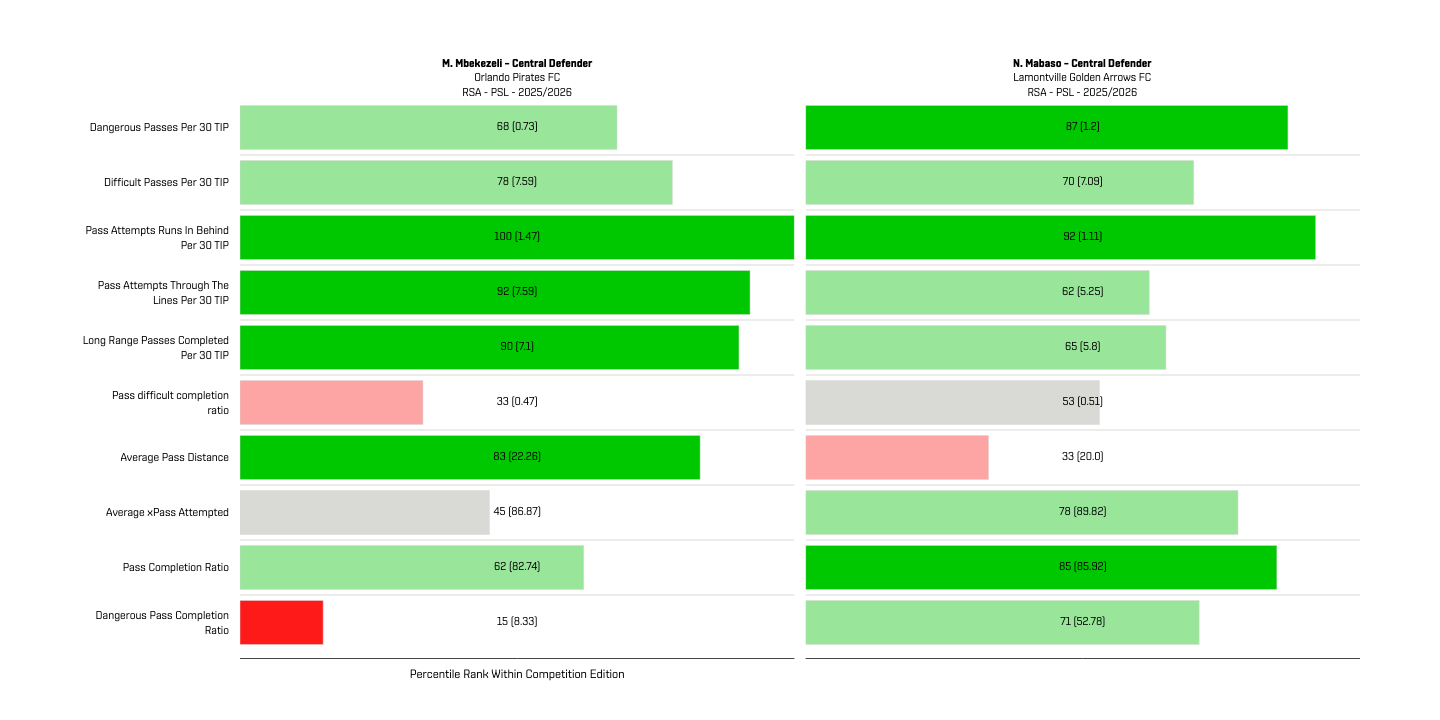
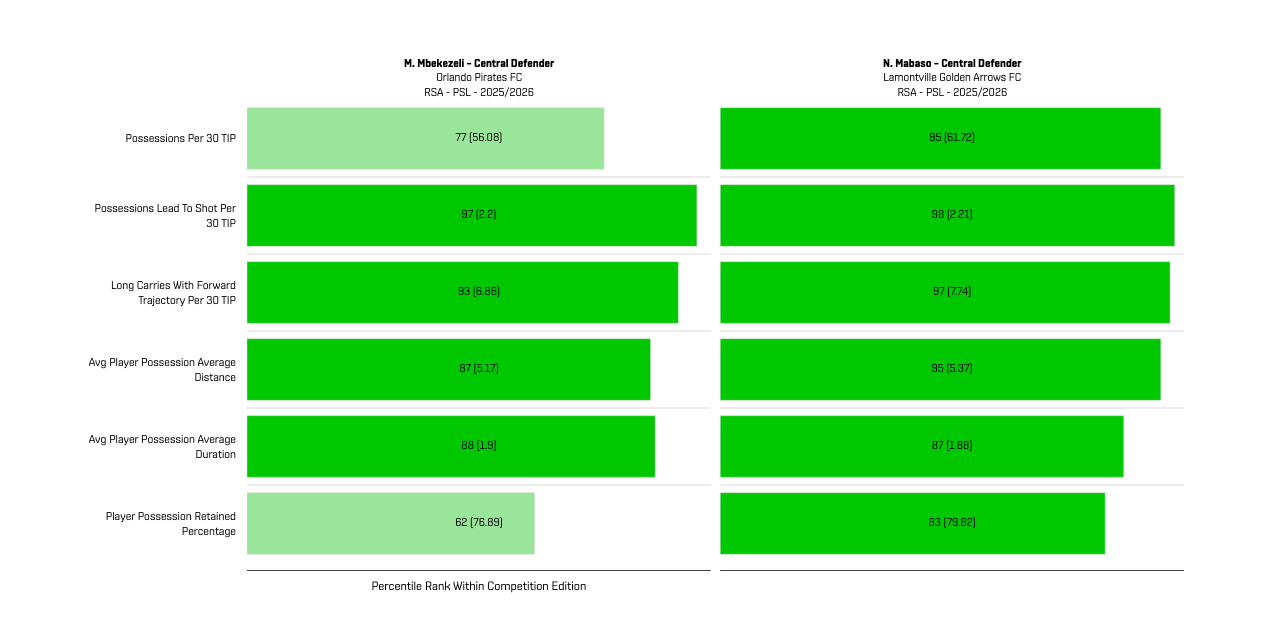
However, this desirable on-ball composure is further exemplified by Mabaso’s impressive Possession-based metrics.
His 1.72m height may put off clubs looking to sign him as a centre-back, but Lamontville Golden Arrows have seen fit to provide his nickname on the club website. The Beast does not share the same top-end speed as Mbokazi - remember, Speed is the MLS calling card - yet his Physical output is not only impressive, but is also characterised by those PSL hallmarks.
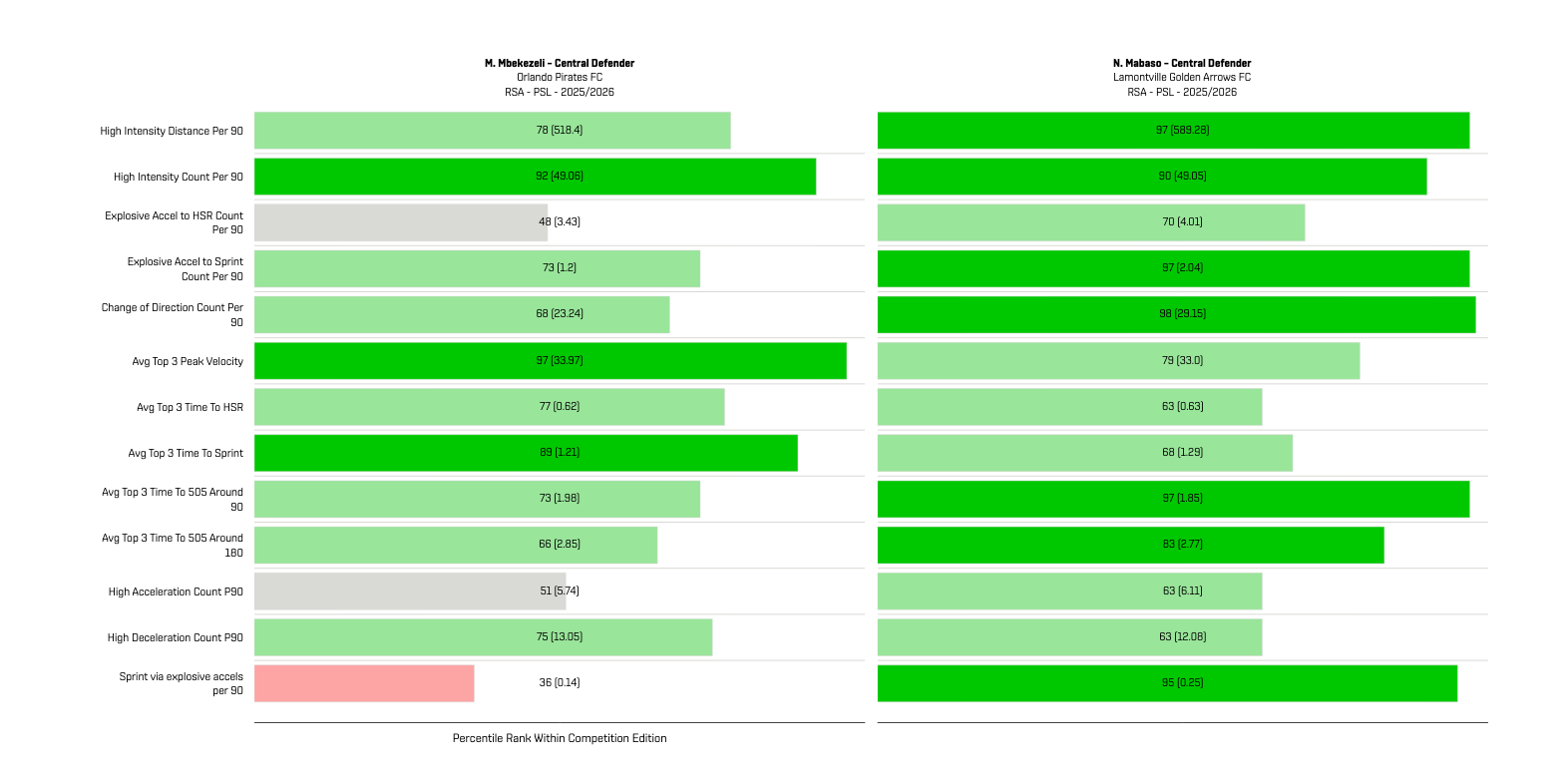
In a league defined by Explosiveness, Mabaso is one of the most explosive and agile centre-backs. Combine this with his value in possession and there is no reason why he could not excel as a left-sided defender in a back three, or even a full-back in certain set-ups.
The final trait highlighted by Berhalter related to their second signing, Puso Dithejane. Technical quality and comfort in tight spaces were the scouting signals - the latter already ties into the agility and explosiveness we’re starting to associate with the PSL.
When exploring these attributes, Sphesihle Jeza, a 2006-born wide forward for Siwelele FC, jumped out from the WebApp Lab. We can capture comfort in tight spaces through a combination of Passing Option and Reception metrics from SkillCorner’s Game Intelligence suite.

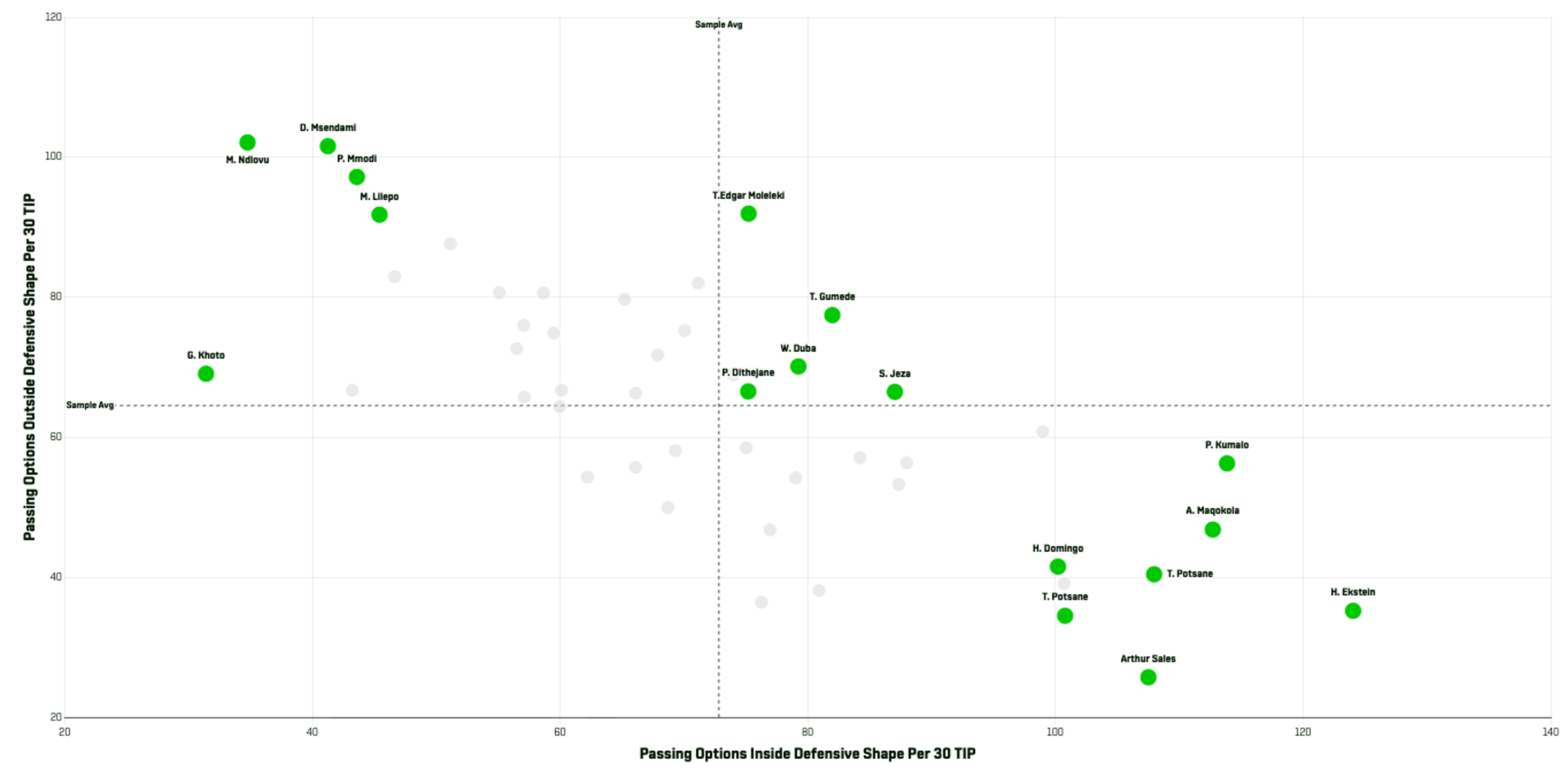
Passing Options are especially useful when it comes to localising a player’s true position. At SCOUTED, we call this the Area of Effect. By that, we mean going beyond the team sheet to see which pockets of space a player enjoys drifting into and operating from. Jeze, for example, ranks higher for Passing Options Through the Lines than he does Around the Lines while also ranking higher for Passing Options Inside the Defensive Shape than for Options Outside the Defensive Shape. This suggests there may be a natural instinct to drift into the smaller gaps rather than hang out wide to receive in space.
However, when plotting the league’s pool of Wide Attackers on these two metrics, we see that both Jeza and Chicago Fire signing Puso, are two of just five players to rank above average for both. This suggests they’re comfortable receiving inside but that it is not a definitive stylistic trait of either. The extreme profiles, potentially specialists, can be found in the top left and the bottom right of the below chart.
Now we know that Jeza is able to receive in tight spaces - but does not relentlessly seek them out - we can begin to evaluate his behaviour and effectiveness in these situations by looking at his Receptions. This next collection of metrics is quite spectacular.
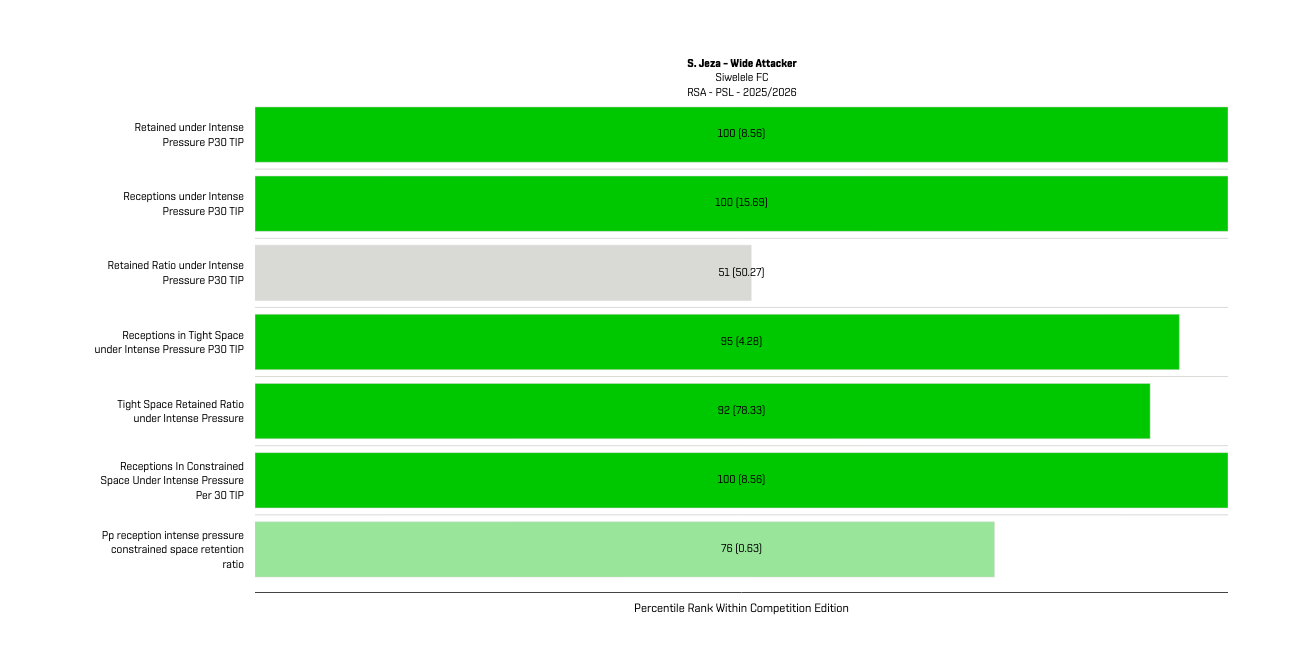
Jeza ranks in the top percentile for Receptions under Intense Pressure P30 TIP, Receptions in Constrained Space under Intense Pressure P30 TIP and in the top 5% for Receptions in Tight Space under Intense Pressure; he is certainly familiar with these small pockets.
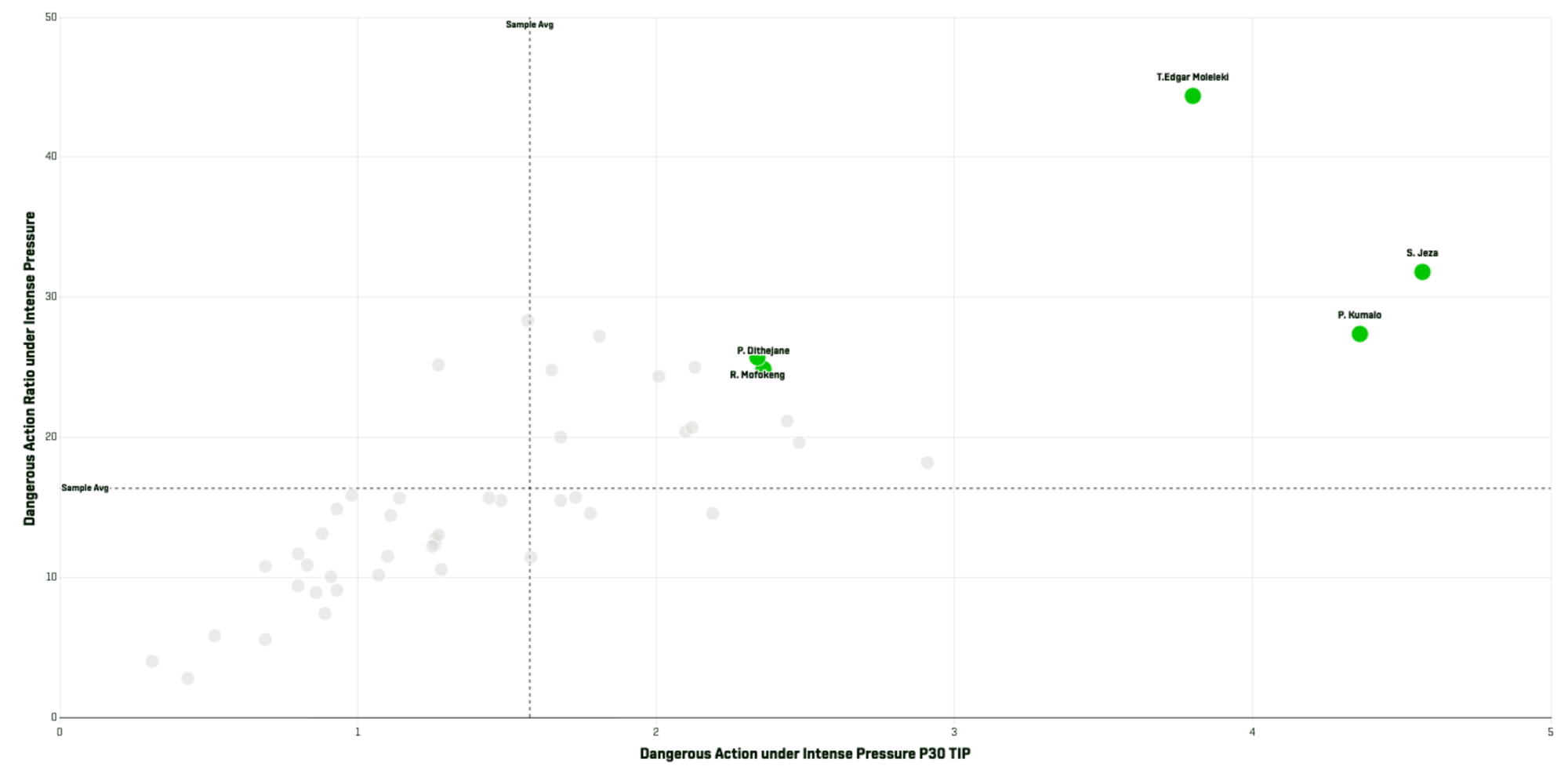
But the next set of metrics illustrate both the South African's comfort and devastating effectiveness in them. Jeza ranks in the top percentile for Escaped Pressure, Dangerous Actions under Intense Pressure and Dangerous Action Ratio under Intense Pressure. This is a remarkable triple, even from a six-match sample.
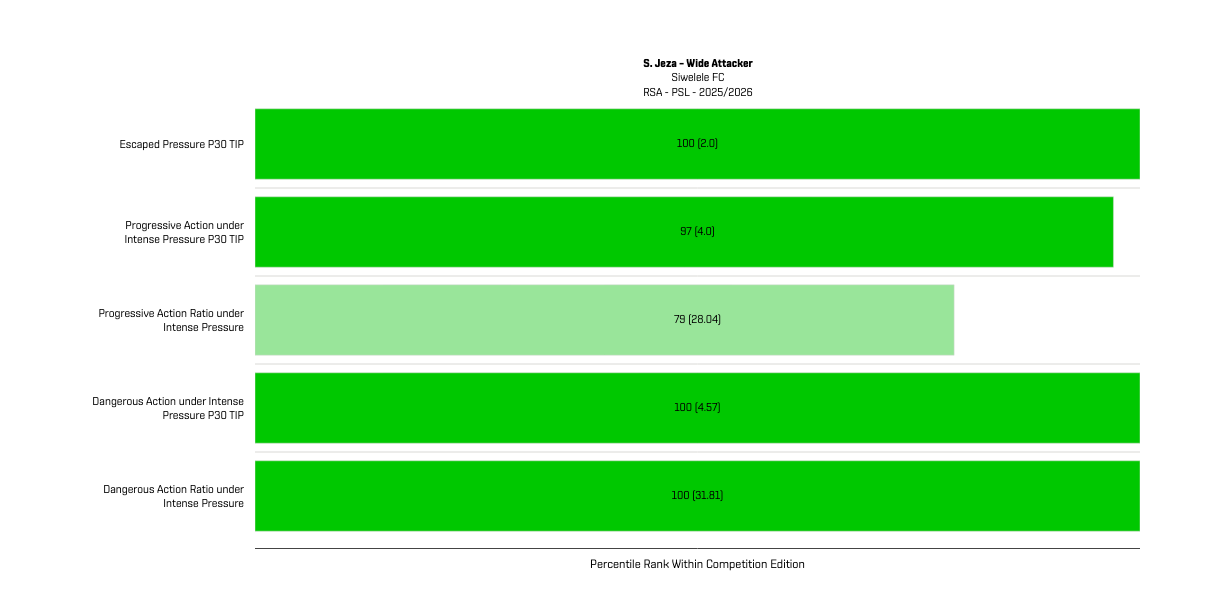
Jeza does not just retain the ball upon reception in these tight spaces, he is consistently able to move the ball closer to goal and generate threat in the face of opposition pressure.
Technical quality is something that needs to be assessed through further video or live scouting, but it’s worth glancing over the Physical attributes to finish.
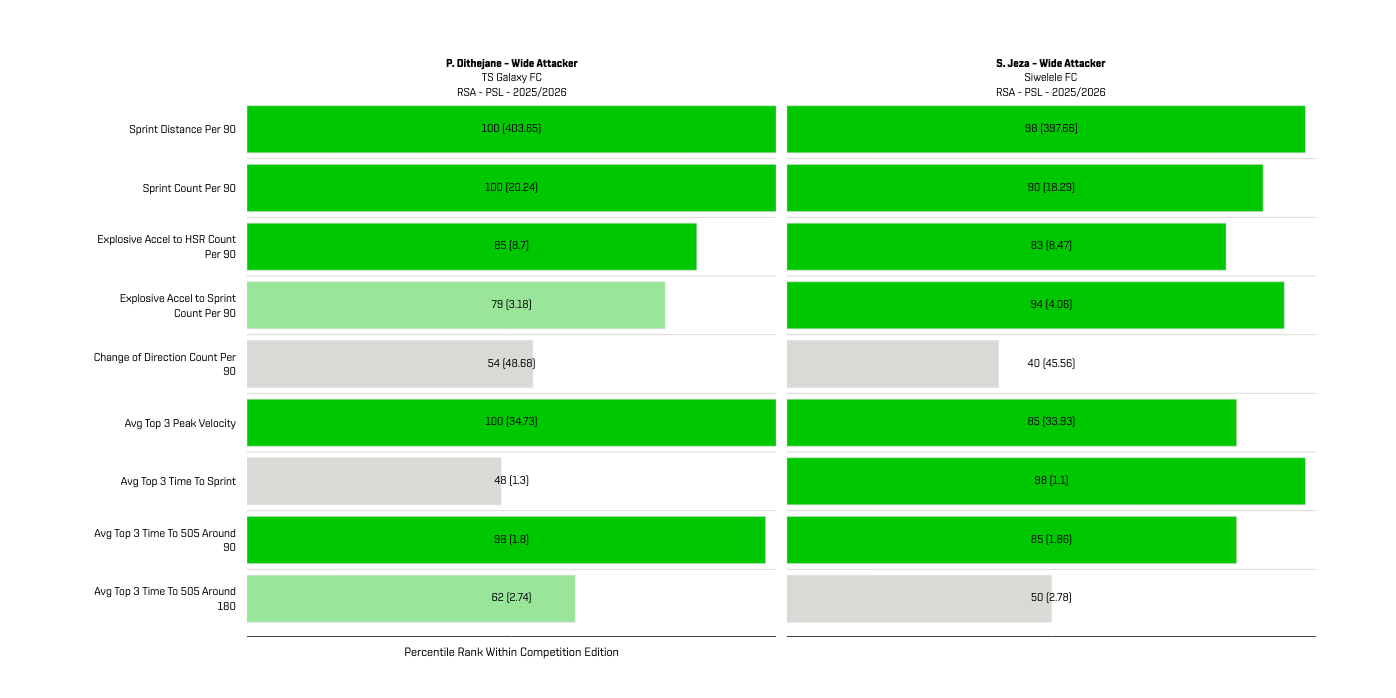
In comparison to Puso, who clearly ticks plenty of MLS boxes as a sprinter, Jeza indexes more into that bursty, explosive profile that should now be synonymous with the PSL.
The world is waking up to South Africa. It’s not just MLS franchises scouring the PSL: Belgian clubs are on the move, and you should know what that means by now.

This summer, Royale Union Saint-Gilloise signed Relebohile Mofokeng from Orlando Pirates for a South African record fee of €3.5 million, while RSC Charleroi picked up Isaac Ismaël Cissé, a teenage Ivorian midfielder the Golden Arrows nicknamed the Compass. In recent weeks, Scandinavia joined the party: F.C. København signed Thapelo Maseko, another member of the 2026 World Cup squad, for €1.5 million from Mamelodi Sundowns.
With revelations about the Physical standard of the league, made possible through SkillCorner data, combined with the accessible financial entry point for most top-flight leagues, the PSL pipeline to MLS is set to burst and wash a flood of talent across Europe.
.png)