

How Do Physical Outputs Change Throughout The World Cup?
We delved into SkillCorner data to find out.
SkillCorner was one of the first movers in scalable physical data and one of the advantages of that is that we have an increasingly large dataset with which to analyse wider trends and interrogate interesting questions.
From previous work we know that physical outputs generally increase as elite club competitions like the Champions League progress to their final rounds. The stakes and intensity rise in unison.
With the 2026 World Cup soon to kick off, we wanted to see if that same pattern holds in the more condensed schedule of a major international tournament
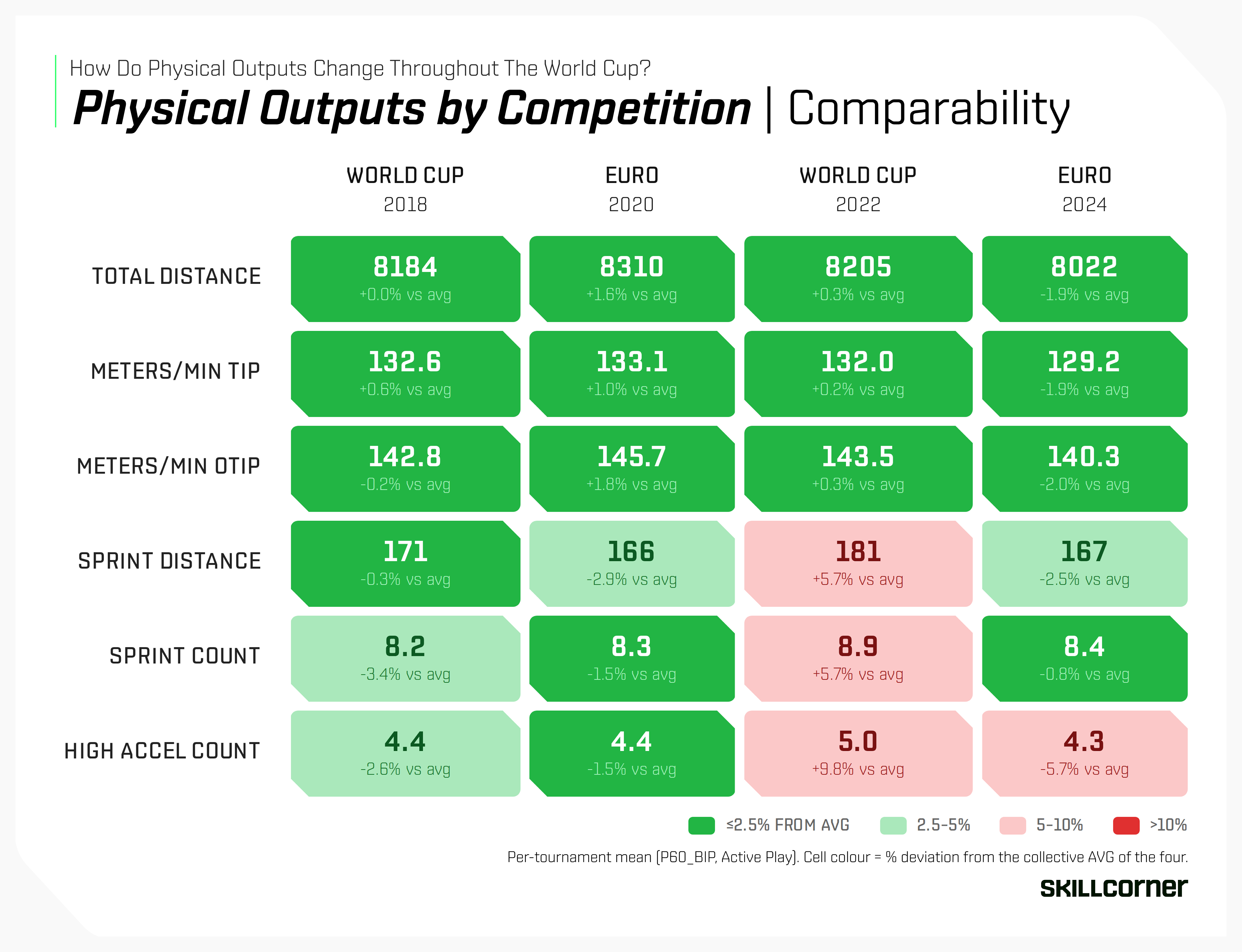
To answer that question we have accumulated the data from the last four with an equivalent structure – the 2018 and 2022 World Cups, plus the 2020 and 2024 European Championships – and looked at six key physical metrics:
- Total Distance
- Meters/Min in possession (TIP)
- Meters/Min out of possession (OTIP)
- Sprint Distance (Distance at >25 km/h)
- Sprint Count (Discrete activity at >25 km/h)
- High Accelerations (Discrete activity exceeding 3 m/s²)
As you can see below, the four chosen competitions all had outputs within a comparable range for each of the metrics, providing us with a solid dataset from which to draw credible conclusions.
In this analysis, we will look at how outputs for each of these metrics evolve over the course of an international tournament.
Ball in Play Time
Firstly, though, we will look at ball-in-play time. All the metrics in this analysis are normalised to 60 minutes of active play time, but it is still worth understanding how it changes throughout these competitions.
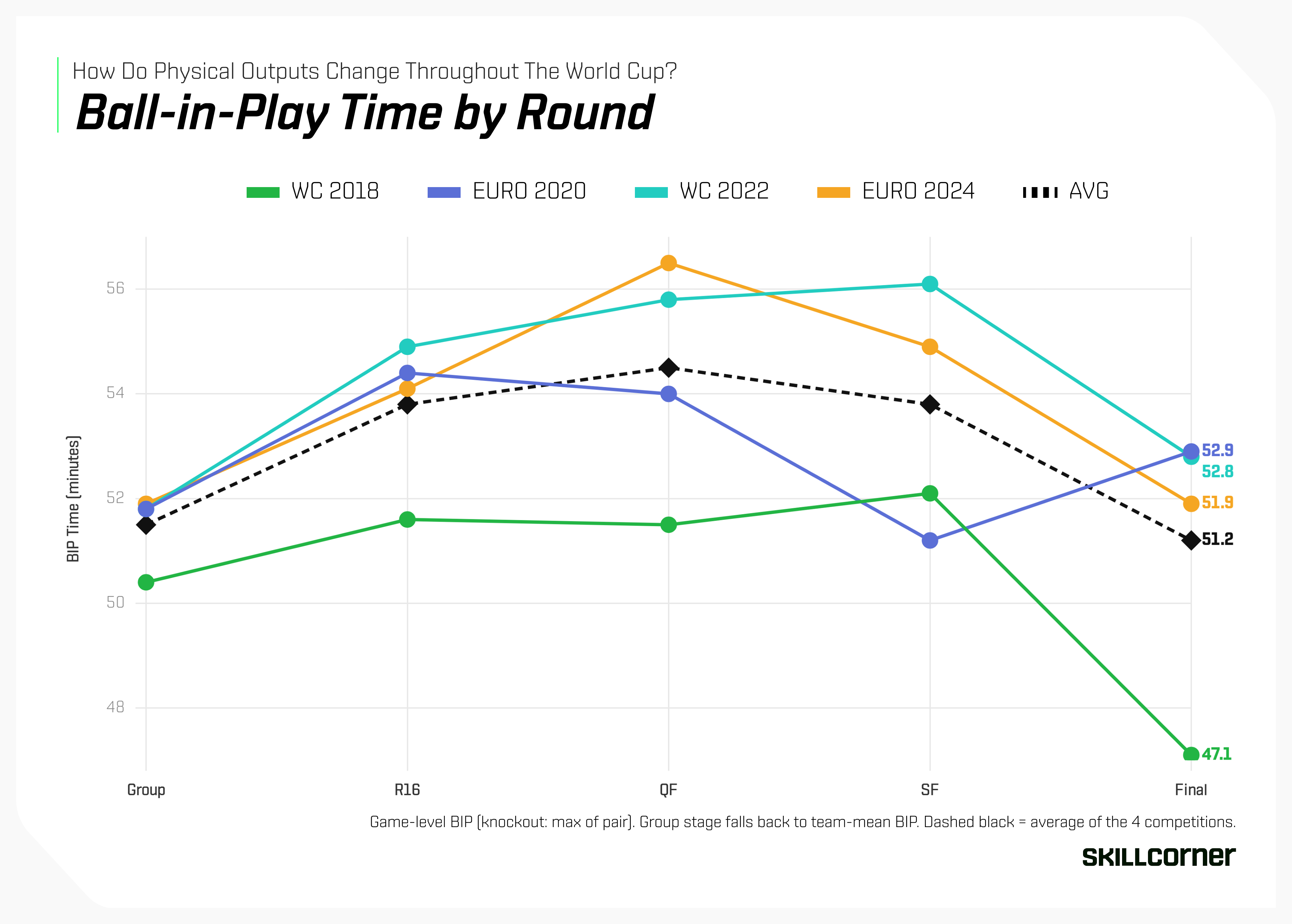
The general trend is for ball-in-play time to be at its lowest during the group stage and in the final, which makes some degree of intuitive sense. We’d expect to see a lower average quality of teams during the group stage, which generally results in less active play time, while the final is then the match that combines the highest stakes with the greatest fatigue.
The dropoff in the 2018 World Cup final between France and Croatia is particularly notable.
Physical Outputs
With that context provided, let’s move on to the primary substance of the analysis: physical outputs.
If we look at the numbers across our six chosen metrics, some patterns immediately emerge.
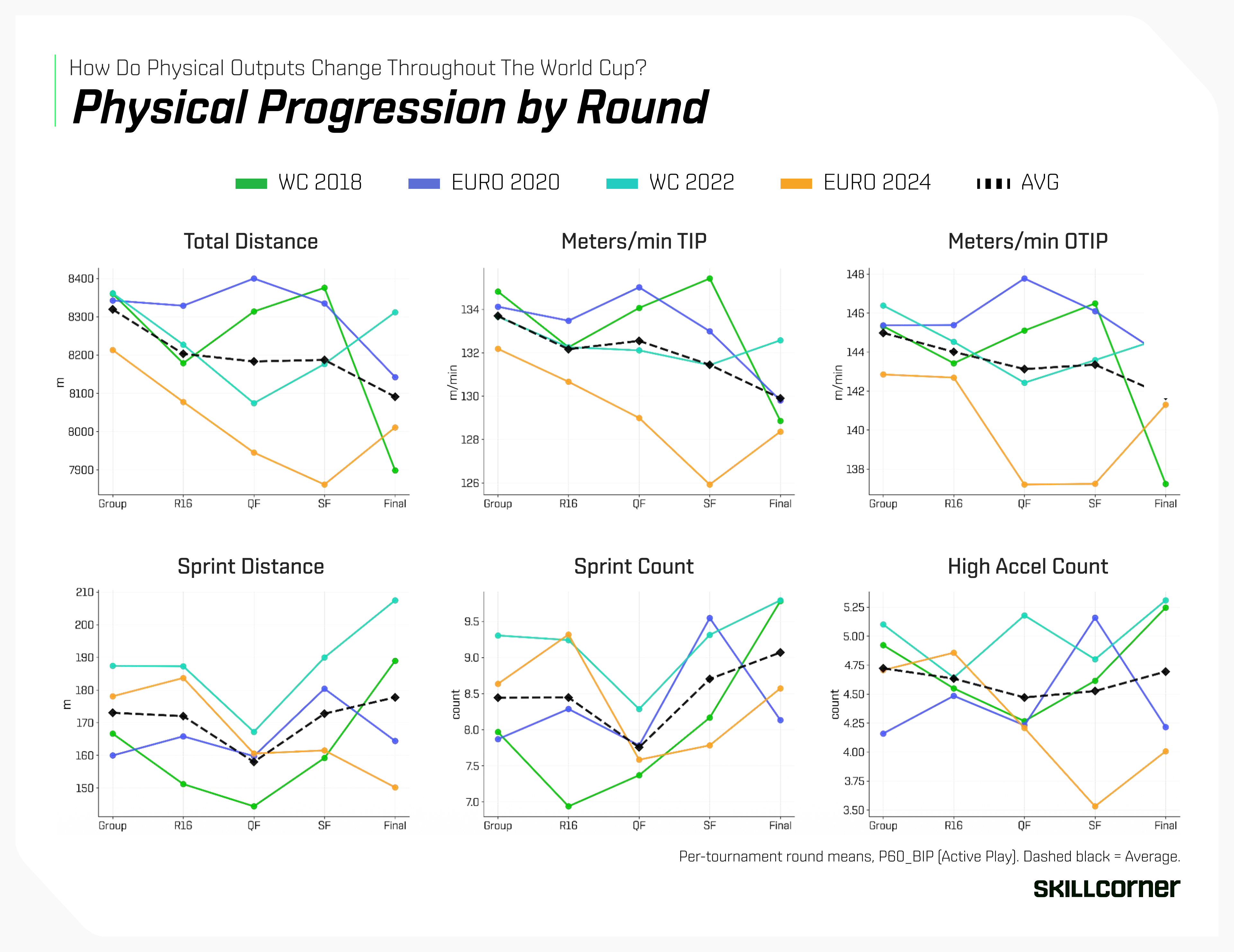
The clearest is the contrast between the total distance measures and those related to higher intensity actions. While the average value for Total Distance and the equivalent in and out-of-possession distances all reduce over the course of tournament play, those for Sprint Distance and Sprint Count dip after the group stage and round of 16 only to ramp up again for the decisive matches, hitting their peak in the final.
Again, this makes intuitive sense. Even as fatigue and load builds up through the tournament and teams begin to cover less total ground, the competitive stakes still necessitate bursts of the highest intensity activity. It is notable that the rise in Sprint Count is steeper than that in Sprint Distance; players sprint the most in semi-finals and finals, but in slightly shorter bursts than earlier in the tournament.
The count of High Accelerations also broadly follows that pattern, with the last two World Cups both seeing their peak values in the final.
But it is worth noting that while these patterns exist in aggregate, they are far from homogeneous across all four tournaments.
Physical Outputs for Semi-Finalists
Looking at the overall progression of physical outputs through tournament play helps identify trends, but it is also worth honing in on the teams that made it through to the semi-finals to understand how outputs evolve across those who have to carry the load of six or seven matches.
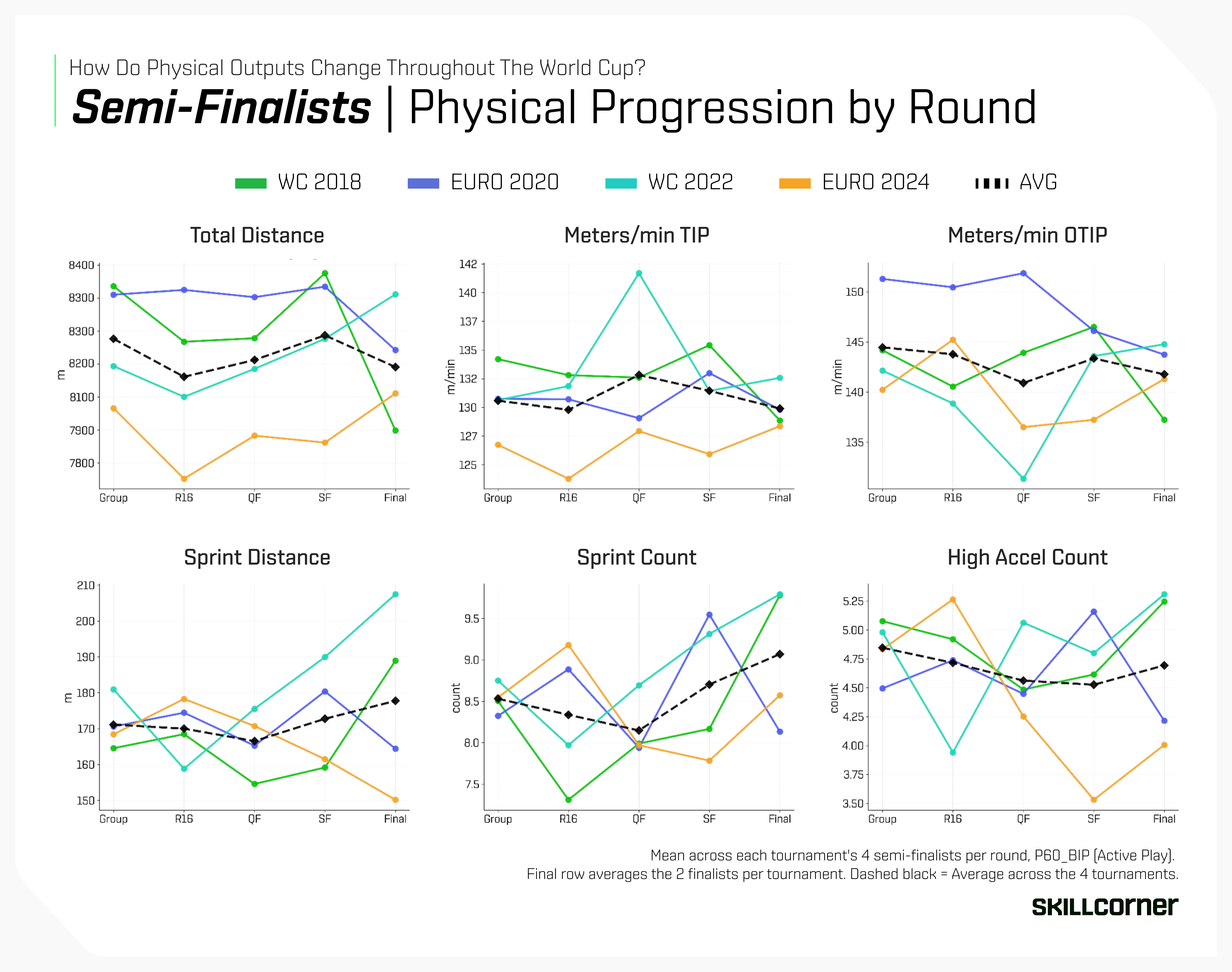
Sample sizes are clearly smaller, so some additional per-tournament variance is to be expected – see the huge jump in Meters/min TIP for the 2022 World Cup quarter-finals as a result of Morocco’s output against Portugal – but the average numbers tell an interesting story that supports some of our earlier analysis.
We still see similar patterns in terms of Sprint Distance and Sprint Count, with both rising in the latter stages of the tournament. And again, we see the same steeper rise for Sprint Count. This all affirms our previous assertion that the competitive stakes require additional bursts of the highest intensity activity regardless of overall player fatigue.
But there are some differences in terms of the Total Distance measures. On average, the semi-finalists covered almost 150 metres less distance per match during the group stage than the overall number, and that lower starting point means that we see a more balanced progression through the tournament in these metrics. Less ground is covered in the final than in the group stage, but the difference is not as pronounced as in the global number
How might we explain that?
We can perhaps assume there are a greater number of quality mismatches during the group stage, resulting in more total distance being covered by teams keen to make up that differential by outrunning their opponents. Maybe, too, that the strongest teams orientate their conditioning work towards going far into the tournament, in contrast to weaker teams for whom progressing from the group is their primary goal.
But those are certainly just theories, and we would need a larger sample size to interrogate them further.
Things to Watch Out For: 2026 World Cup
The 2026 World Cup, jointly hosted by the United States, Mexico and Canada, presents some new challenges to players and conditioning staff.
- An extra round of matches: The 48-team field requires an extra knockout round, meaning that the finalists will play eight matches instead of the customary seven.
- Extreme heat: Physical outputs generally decrease in extreme temperatures (as an upcoming CIES report with SkillCorner data will show); in this specific geographical context, we see a clear decrease in physical outputs over the summer in Major League Soccer.
- Increased travel: The sheer geographical spread of the host cities will necessitate significant long-distance travel. At a minimum, teams who reach the quarter-finals could be expected to log over 5,000 kilometres and in some cases closer to 9,000. The contrast to the last World Cup in Qatar will be stark.
We would expect all of those factors to affect physical outputs, although it also remains to be seen to what extent the reduced jeopardy of the group stage – with only a third of the field set to be eliminated – will allow some of the better teams to offset this additional load by rotating and resting players.
We look forward to seeing what happens out on the pitch.