Metric Explainer: On-Ball Engagements – Pressing
We can now identify when a player presses the ball-carrier as part of a coordinated team effort, and how effective that action is at affecting the opposition’s play.
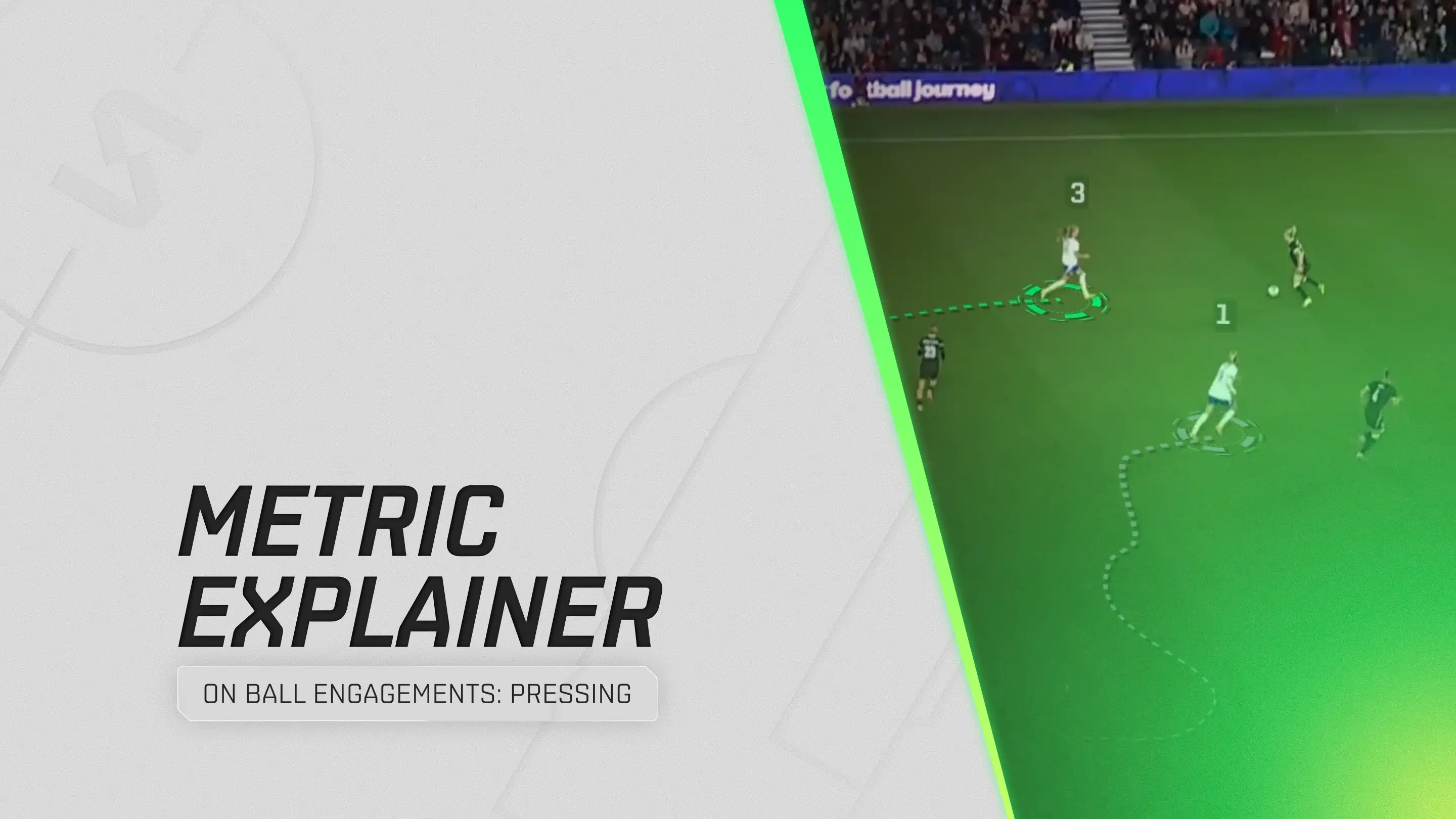
A player’s defensive behaviour reveals how they affect the game without the ball: how they close down the ball-carrier, control space, and shape the opponent’s next decision.
In scouting and recruitment this is useful information to profile players by the volume and quality of their defensive output, showcasing whether they fit a given defensive system. In match analysis, it surfaces the individual and collective patterns behind a team’s pressing.
Event data has always struggled to measure real defensive contribution. It records the completed action — the tackle, interception, etc. — but only when a defender actually touches the ball, missing key contextual information. A player who forces a backward pass, pushes the carrier wide, or closes a passing lane goes completely unrecorded.
This is where On-Ball Engagements come in. They exist whether or not the pressing player touches the ball, capturing the volume and effectiveness of a player or team’s defensive behaviour and providing the foundation for deeper and more applicable analysis.

Each On-Ball Engagement is described by the type of pressure it represents:
- Pressing — engaging an opponent as part of a coordinated defensive chain.
- Pressure — individually applying direct pressure to the ball-carrier.
- Recovery Press — running back towards the own goal to pressure the ball-carrier.
- Counter Press — applying pressure within 3 seconds of a turnover.
It also records the outcome of the engagement, measuring pressure by its effect on the opponent:
- Reduces Possession Danger — the player lowers the danger of the opposition’s possession in a dangerous situation.
- Stops Possession Danger — the player makes a direct action (tackle, interception or block) that breaks up the attacking sequence.
- Forced Backward — the player forces the carrier to pass or carry back towards their own goal.
- Line Break Prevention — the player prevents a pass to a line-breaking option.
- Beaten by Movement — the attacker’s off-ball movement beats the defender before receiving.
- Beaten by Possession — the carrier beats the defender while on the ball.
Each engagement is also classified by the phase of play in which it occurs: high, mid or low block.
We start with Pressing — actions applied to the ball-carrier as part of a coordinated team chain — looking at how often a player performs this action and analysing the result of their efforts.
Applied Use Case
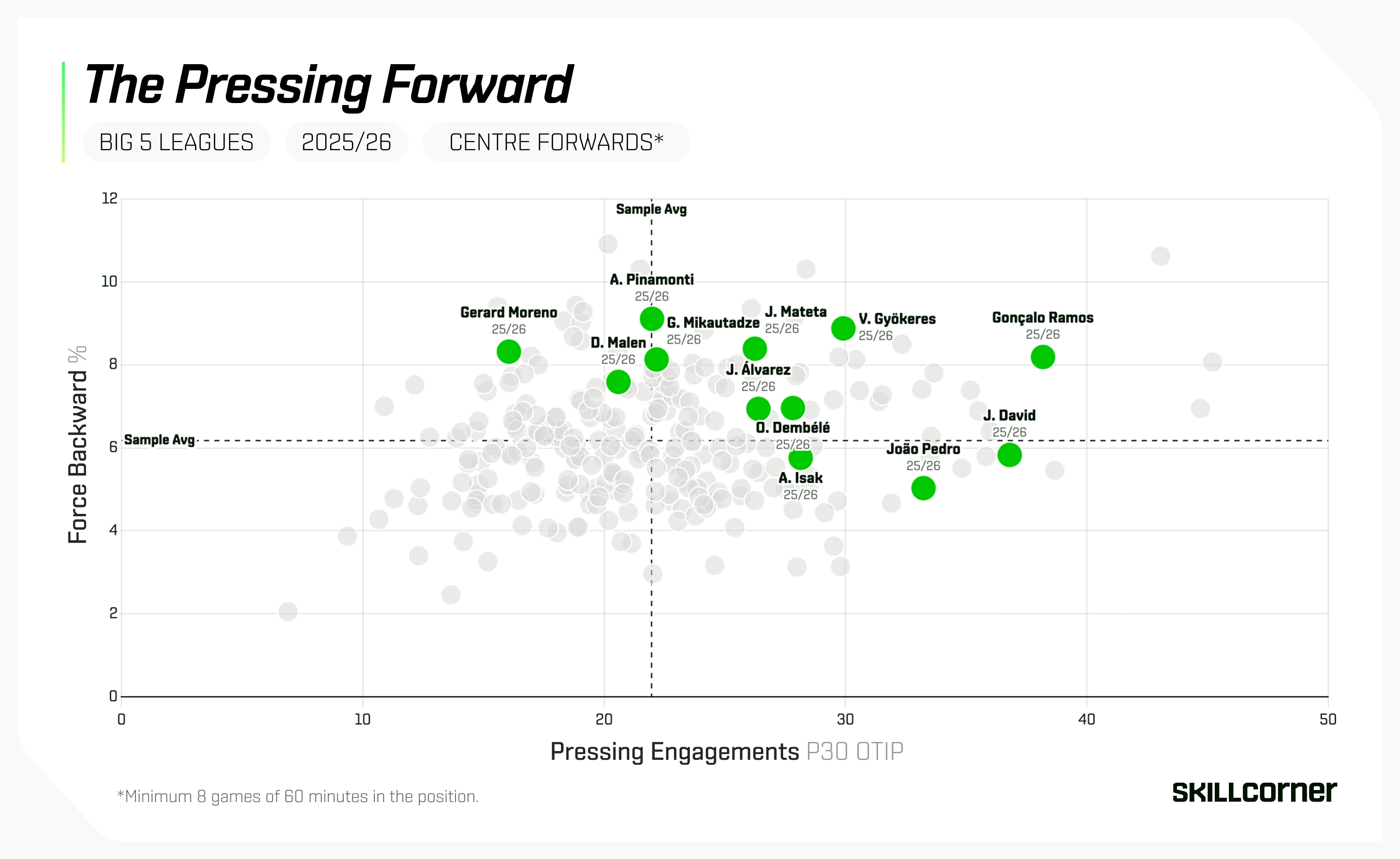
The Pressing Forward
The centre forward’s defensive movement often defines the whole team’s pressing shape: setting its height, from an aggressive high press to a more contained block, and directing the ball-carrier towards a specific side or area of the pitch where the team is well-structured to regain possession.
Plotting Pressing Engagements against Force Backward Percentage separates the forwards who press most often from those who press most effectively, preventing ball progression.
Metric Definition
Pressing Engagements is the number of times a player applies direct pressure to the ball-carrier as part of a pressing chain, measured per 30 minutes of opponent time in possession (OTIP).
Force Backward Percentage is the share of a player's On-Ball Engagements that force the ball-carrier to pass or carry backwards, towards their own goal. It is a measure of the pressure's effect on the opponent's ability to progress.
On-Ball Engagements are one of the key contextual metric groups that make up our Game Intelligence suite, combining on and off-ball insights for more precise performance and stylistic profiling. Get in touch to learn more.